
Vials are extensively used in the packaging of injections, biological products, lyophilized drugs, and other pharmaceutical preparations. Unlike regular liquid filling, vial filling requires consideration of the issues of filling accuracy, vial alignment, a sterile environment in production, and further stoppering and capping. So, a Pharmaceutical Vial Filling Machine would normally be part of the whole vial packaging system rather than a stand-alone machine. The quantity of filling heads, filling approach, and degree of automation must be chosen based on product features, vial sizes, and the required capacity.
How Does a Pharmaceutical Vial Filling Machine Work?
A Pharmaceutical Vial Filling Machine moves empty vials to the filling station, aligns them beneath the filling needles, and fills a specific amount of pharmaceutical liquid into each vial.
A typical working sequence includes:
- Empty vials enter the conveying area.
- The positioning system holds the vials in the filling position.
- Filling needles move to the preset height.
- The filling system dispenses the required volume.
- Filled vials move to the stoppering and capping stages.
For example, a machine equipped with 4 filling heads can fill four vials during one filling cycle. The actual output, however, depends on the filling volume, liquid flow characteristics, vial dimensions, and cycle time. The number of filling heads alone does not determine the final production rate.
What Are the Main Components of a Pharmaceutical Vial Filling Machine?
A pharmaceutical vial filling machine normally comprises a filling system, filling needles, vial positioning system, conveyor system, and control system. Each one of them plays a vital role in ensuring steady filling.
Filling System
This system provides the filling of the pharmaceutical liquid into the vials as per predetermined filling volume. Depending upon the product type, different systems could be selected based on factors such as viscosity of the liquid, range of filling, and process requirement.
Filling Needles and Vials Positioning System
Filling needles fill the pharmaceutical liquid into the vials. The positioning system ensures the correct position of the vials during the process. Since most of the pharmaceutical vials have a narrow opening, therefore, alignment of the vial with the filling needle is very important for smooth operation.
Conveyor and Control System
The conveyor system moves the vials from one station to another. The control system controls parameters such as filling volume, speed of operation, and timing of the cycle. An automatic control system reduces repetitive activities and ensures consistency in setting up for each batch.
What Types of Products Can a Pharmaceutical Vial Filling Machine Fill?
The suitability of a Pharmaceutical Vial Filling Machine depends largely on the physical properties of the pharmaceutical product and its manufacturing process. Common applications include:
| Product Type | Typical Characteristics | Key Considerations |
| Injectable solutions | Usually good fluidity | Filling accuracy and sterile conditions |
| Biological products | Sensitive to process conditions | Temperature, shear, and sterility |
| Lyophilized products | Followed by freeze-drying | Fill-volume consistency |
| Other liquid medicines | Formulations vary | Viscosity, foaming, and metering |
Before selecting a Pharmaceutical Vial Filling Machine, manufacturers should confirm the product’s viscosity, density, filling volume, and foaming characteristics. These factors can affect both the filling method and the operating parameters.
What Should You Know Before Using a Pharmaceutical Vial Filling Machine?
Choosing a Pharmaceutical Vial Filling Machine is based on the analysis of actual production parameters rather than machine specification comparison alone.
Vial fill volume: Determine the volume of filling per vial, for example, 2 mL, 5 mL, or 10 mL.
Production capacity: Specify the required production rate and choose the required number of filling heads and operational speed.
Vial dimensions: The size of vials, including the diameter, height, and neck, will determine the position of filling needles.
Product properties: The viscosity, foamability, and thermal sensitivity of the product will affect the filling process.
Cleaning requirements: Product-contact parts should be easy to clean and compatible with the production process.
Automation level: Choose a semi-automatic, automatic, or integrated system according to production scale and labor requirements.
For applications that require filling and sealing in one continuous process, the ZONESUN 4 Heads Vial Filling Capping Machine offers an integrated configuration. Its main features include:
- Four filling heads: Four vials can be filled during each filling cycle, helping improve efficiency for small- and medium-scale production.
- Integrated stoppering and capping: After filling, the machine can continue with vial stoppering and capping, reducing manual transfer between separate machines.
- Continuous workflow: Filling, stoppering, and capping are arranged in sequence to support a more organized vial packaging process.
- Reduced manual handling: The integrated design helps limit repeated movement of filled vials and can improve process consistency.
- Suitable for vial packaging applications: The machine can be considered for pharmaceutical, biological, and other liquid products packaged in vials, subject to product and container compatibility.
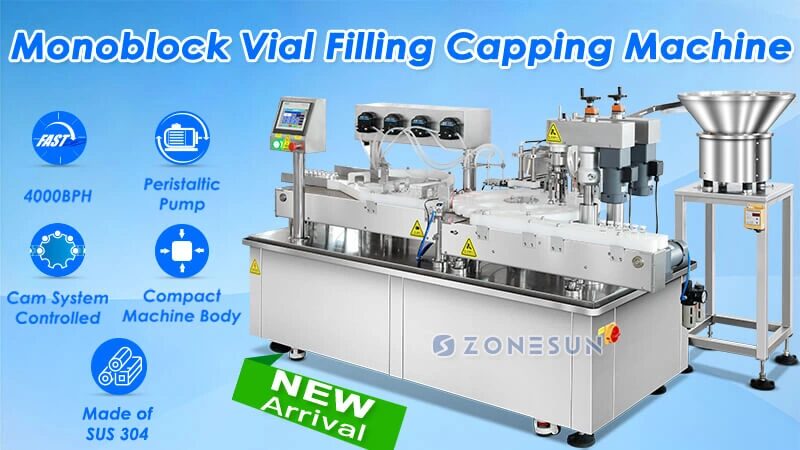
Adjustable production parameters: Filling volume, operating speed, and other settings can be configured according to the product, vial size, and required output.
An alternative integrated machine is the ZONESUN-Vial Filling Stoppering Machine that performs the operations of vial sorting, liquid filling, and stoppering in one machine. Its key specifications are as follows:
- Integrated Operations: Performs vial sorting, liquid filling, and stoppering operations.
- Peristaltic Pump: Ensures accurate dosing of liquids through its controlled action.
- Automatic Vial Handling: The automatic vial unscrambler system ensures sorting and loading of vials into the filling area.
- Consistent Operations: Ensures coordination of filling and stoppering processes for continuous and reliable operations.
- Increased Efficiency: Increases the efficiency of packaging operations through minimized manual interventions and simpler setup of the packaging area.
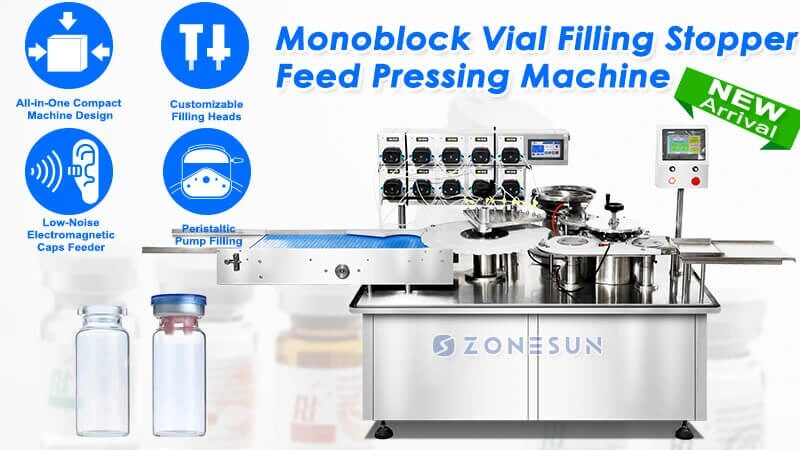
The actual production capacity and filling performance depend on factors such as filling volume, liquid viscosity, vial dimensions, and operating conditions. Manufacturers should confirm these requirements before selecting the final machine configuration.
5. Conclusion
A pharmaceutical vial filling machine is an example of equipment that fills a definite quantity of a pharmaceutical liquid in vials with precision. Main components of the machine include a filling system, needles, vial positioning, conveyor, and control systems that together are involved in carrying out the dosing process. Within the whole process of vial packaging, the filled vials may move on to stoppering, capping, and other operations.
To put it differently, the machine is not just a simple liquid-dispensing device. It is a vital component of vial packaging that links the exact liquid filling with the handling of pharmaceutical packages. The design of the machine may differ depending on the product, specification of vials, and volume of filling. If you want to get more information about vial filling machines, you may contact ZONESUN.