
Vial filling is a very common practice in the field of pharmaceutical and biotech industry, which requires the use of tiny glass vials as the means of storage. While the steps involved in the process, i.e., filling the vial and putting the stopper on it, seem to be simple tasks, each of them needs to be performed consistently in case there is an increased volume of production. The quantity of the liquid being filled, the orientation of the vial, stopper insertion, and speed of transfer are among the factors that may influence the outcome. Vial Filling and Stoppering Machines unite all the mentioned processes into one.
1. How Does a Vial Filling and Stoppering Machine Work?
Vial Feeding and Positioning
The feeding mechanism controls the movement of empty vials and keeps them in the correct orientation. Depending on the machine design, this function may be performed by a conveyor, star wheel, or other vial-handling device.
The positioning mechanism holds each vial securely beneath the filling nozzle. This alignment allows the liquid to enter the container accurately and helps reduce splashing, spillage, and filling variation
Filling Mechanism
Once the vials are correctly positioned, the filling system delivers a preset amount of liquid into each container. Peristaltic pumps are commonly used in certain applications because the liquid travels through flexible tubing rather than directly through the pump body. This design can simplify cleaning and product changeover while providing controlled liquid transfer.
Stoppering Mechanism
The stoppering mechanism organizes and places rubber stoppers over vial openings before pressing them into position. Proper alignment is essential for an effective seal, so the stopper dimensions, vial neck design, and pressing force must be compatible. After stoppering, the closed vials can move to subsequent processes such as crimping, inspection, labeling, or secondary packaging.
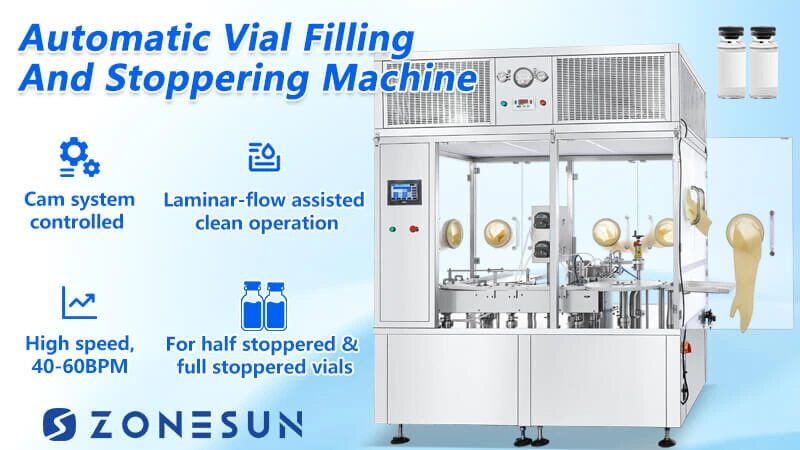
The ZONESUN ZS-AFC9H Machine is designed for high-speed vial filling and stoppering. Its main features include:
- Filling System: Peristaltic pump with 2 filling nozzles
- Filling Accuracy: Up to ±3%
- Filling Range: Customizable according to product requirements
- Production Speed: Up to approximately 3,600 bottles/hour
This configuration is suitable for manufacturers looking for a compact system that combines liquid filling and vial stoppering in one process.
2. Why Use a Vial Filling and Stoppering Machine?
In manual small-scale production, it is possible to fill and close vials without special devices. The difficulty of this process becomes evident when hundreds or thousands of containers have to be processed during one shift. Manual filling may cause variations in liquid volume, while manual positioning of stoppers leads to inconsistency among batches. A Vial Filling and Stoppering Machine solves this problem by combining a number of processes in one production process that is controlled.
Consistency of Filling
Consistency of filling is especially important for small volumes of product. In case the container contains only 2 or 5 milliliters of liquid, slight variations become quite a significant part of the volume. Parameters such as speed of pump operation, time of filling, and dose of the liquid used in an automated system allow for better control of the filling process.
Less Repetitive Handling
Manual production requires operators to repeatedly pick up vials, position them, fill the containers, place stoppers, and move the finished units to the next stage. A vial filling and Stoppering Machine reduces much of this repetitive work. It also creates a more predictable production rhythm, which becomes useful when production runs need to continue for several hours.
3. What Factors Affect the Choice of a Vial Filling and Stoppering Machine?
Vial Size and Format
The dimensions and shape of the vial should be confirmed first. Vial diameter, height, neck size, and opening design can affect how the container is handled inside the machine. If a manufacturer works with several vial formats, it is worth checking whether the equipment supports adjustable components or interchangeable parts for format changes.
Filling Volume and Liquid Properties
The required filling volume needs to fall within the machine’s suitable operating range. At the same time, the physical characteristics of the liquid should not be overlooked. Viscosity, flow behavior, foaming tendency, and sensitivity to mechanical movement may influence the choice of pump and filling configuration. A filling system that works well for a thin solution may not produce the same results with a thicker formulation.
Stopper Specifications
The stopper must be compatible with both the vial and the stoppering mechanism. Its diameter, shape, material, and flexibility can affect feeding and placement. Manufacturers should also consider whether they use one stopper size or several formats, as frequent changes may require additional change parts and adjustment time.
Production Environment and Future Needs
The available floor space, production schedule, cleaning requirements, and plans for future expansion should also be considered. For example, a manufacturer planning to add crimping, inspection, or labeling equipment may need sufficient room and suitable machine interfaces. Considering these factors before purchasing can help ensure that the Vial Filling and Stoppering Machine remains suitable as production requirements develop.
4. What Production Applications Use a Vial Filling and Stoppering Machine?
A Vial Filling and Stoppering Machine is suitable for a range of liquid products packaged in glass vials. The exact configuration depends on the product formulation, container dimensions, required filling volume, and production environment.
Pharmaceutical Liquids
Pharmaceutical liquids represent another common use. The vials could be used for injection solutions, pharmaceutical liquids, and various other types of pharmaceutical liquids. These products usually have requirements for precise filling and proper sealing, which makes automated machines suitable for their manufacturing.
Biologics and Laboratory Reagents
Biological substances and laboratory reagents can be packed in vials as well. In this case, the manufacturers might focus on dosing, precise handling, and convenient changeovers.
Filling technology must be chosen depending on the characteristics of the liquid. Low-viscosity liquid may differ greatly from a viscous liquid in terms of its behavior; therefore, one pump cannot be used for every type of liquid.
Small-Volume Vial Production
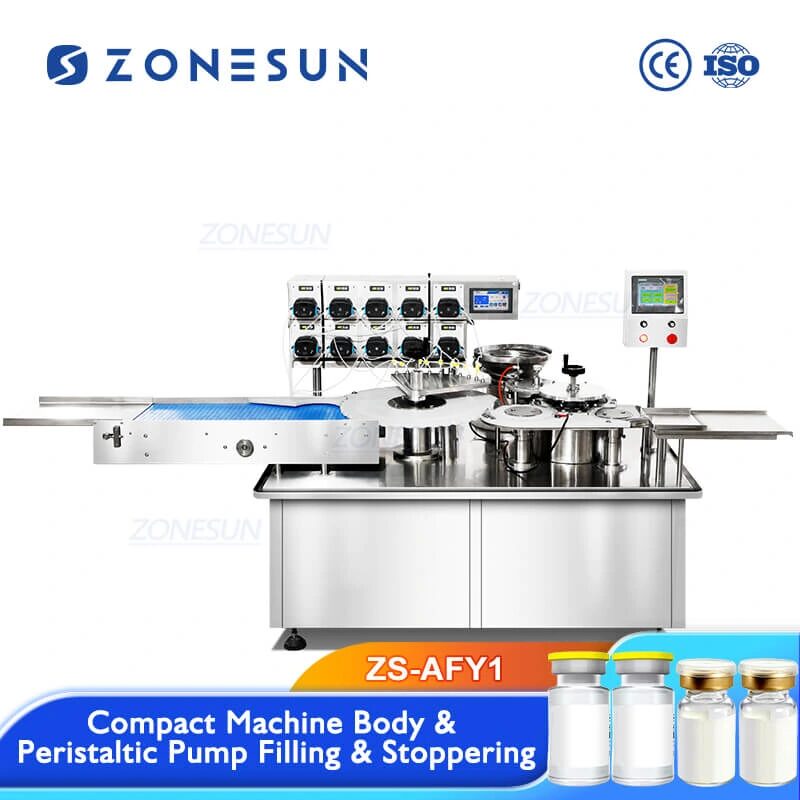
Small-volume containers require particular attention to dosing consistency. The ZONESUN Vial Filling Stoppering Machine is designed for this type of application, with a compact configuration suitable for small vial formats. Key specifications include:
- Filling Volume: Standard 2 mL, customizable
- Filling Accuracy:±1–2%
- Production Capacity: Up to 12,000 BPH
- Customization: Vial and stopper dimensions can be customized
5. Conclusion
A Vial Filling and Stoppering Machine is not just an instrument used for dispensing liquid into glassware. In particular, it involves coordination of vial supplying, positioning, liquid dosing, stopper management, and sealing within the integrated production line. Therefore, this kind of equipment proves to be especially helpful when manufacturers need repetitive work performance, limited manual handling, and an integrated production line that can be followed by packaging equipment.
If you have any questions concerning the Vial Filling and Stoppering Machine, feel free to contact ZONESUN.