
Sealing of bottles made of glass is crucial in the packaging of wines, spirits, fruit wines, olive oil, and other beverages for protection, prevention of pilfering, and maintenance of product quality during storage and transportation. The ROPP capping machine works through controlled roller pressure to roll an aluminum Roll-On Pilfer-Proof (ROPP) cap on the bottle necks.
Since the ROPP caps are not formed in advance but shaped by the capping machine itself, it becomes necessary to consider the bottle neck size, cap size, roller pressure, and speed as factors that will play a part in achieving good sealing. Consequently, selection of the right machine should not be done based only on the speed of the production.
What Is a ROPP Capping Machine?
A ROPP capping machine is a device used for the placement and shaping of the aluminum ROPP caps on the glass bottles. In this regard, the bottles are positioned under the capping heads while the automatic feeding of caps is done. Forming rollers then apply controlled pressure to shape the aluminum cap according to the bottle-neck profile.
A typical machine consists of a bottle conveyor, positioning mechanism, cap-feeding system, capping heads, forming rollers, sensors, and a control system. Depending on the production requirement, machines can be configured with different numbers of capping heads and interchangeable components.
Typical Operating Parameters
Machine specifications vary by configuration and application. Medium-sized systems can process approximately 4,000 to 4,500 bottles per hour, while smaller setups are suitable for low-volume production. Under applicable conditions, this capping machine handles glass bottles ranging from 30 mm to 90 mm in diameter and 100 mm to 330 mm in height.
But rated capacity is not always equal to the actual capacity achieved through production because several factors can determine the throughput of the packaging line, such as bottle stability, cap feeding, and changeover time.
How Does a ROPP Capping Machine Work?
The ROPP Capping Machine mainly completes the capping process in four steps, from bottle positioning to final sealing. Each step must work accurately to ensure consistent capping quality.
1. Bottle Positioning
Filled bottles enter the capping area through a conveyor. Guiding parts, star wheel assemblies, and positioning fixtures accurately align bottles beneath the capping heads, with photoelectric sensors detecting bottle presence.
2. Cap Feeding
Aluminum ROPP caps are automatically fed via a vibrating bowl or feeding system. The caps are sorted into the correct orientation and delivered to the bottle neck, reducing manual handling and maintaining stable production.
3. Roller Forming
The capping head applies controlled pressure while forming rollers shape the aluminum cap around the bottle neck. The cap conforms to the contour of the bottle neck to form a tight seal with tamper-evident features.
4. Capping Quality Control
Stable performance depends on cap diameter, bottle-neck dimensions, roller adjustment, capping pressure, bottle positioning, and machine speed. Improper setting of the equipment will result in loose closures, distortion, leakage, and an inadequate tamper-evident seal.
Why Is ROPP Capping Suitable for Wine and Spirits?
ROPP Capping Machines are commonly employed for wine, spirits, fruit wine, and other bottled-in-glass beverages due to the reliable closure and tamper-evident seal. Aluminum caps also create a clean, consistent appearance. Since bottle height, diameter, and neck design can vary, flexible equipment is important for handling different bottle formats.
For example, a line handling bottles from 150–320 mm in height may require different positioning components for different bottle formats. Interchangeable capping tooling and bottle-positioning components can make format changes easier and help reduce production downtime.
How Can Automation Improve ROPP Capping?
Automation helps reduce manual work, maintain consistent capping quality, and connect the capping process with other packaging equipment. This machine is an ideal choice for lines producing a wide range of bottle specifications. Automatic cap feeding reduces manual placement, bottle detection improves operation safety, and touchscreen controls simplify parameter adjustment and daily operation.
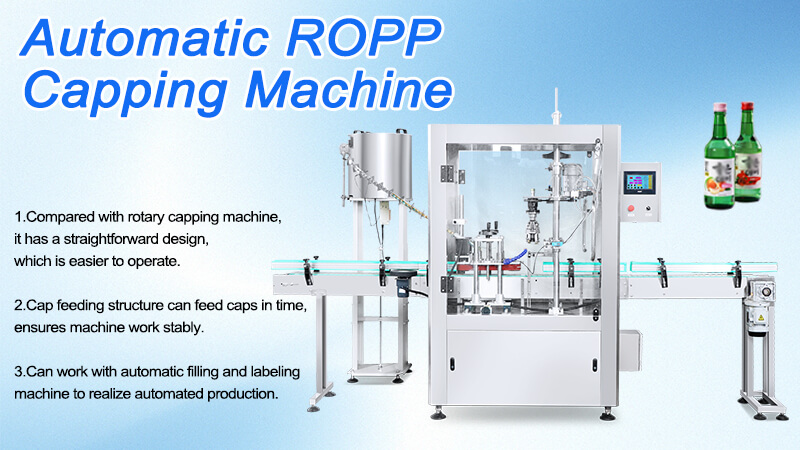
The ZONESUN Automatic Ropp Capping Machine is designed around a straight-line conveying structure and flexible bottle handling. It can be configured for aluminum ROPP caps of approximately 25–38 mm and glass bottles around 150–320 mm in height. This type of configuration can be useful for wine, spirits, olive oil, seasoning beverages, and other production environments where flexibility, automation, and frequent format changes are important. Its main features include:
- Automatic cap feeding: A vibrating bowl and guide track organize and continuously supply caps.
- Bottle detection: Photoelectric sensors detect bottle presence and provide no-bottle/no-capping protection.
- Flexible bottle handling: Tooling can be changed to accommodate different bottle formats.
- Touchscreen operation: Operators can monitor and adjust machine parameters more conveniently.
- Easy line integration: The conveyor and positioning system can connect with filling and labeling equipment.
How to Select a ROPP Capping Machine According to Production Volume?
Automation is not only related to reducing manual work. For larger production facilities, the number of capping heads can directly influence the available throughput. If your production runs only one or a limited range of bottle formats and requires continuous processing of orders, a multi-head configuration will be the more suitable solution.
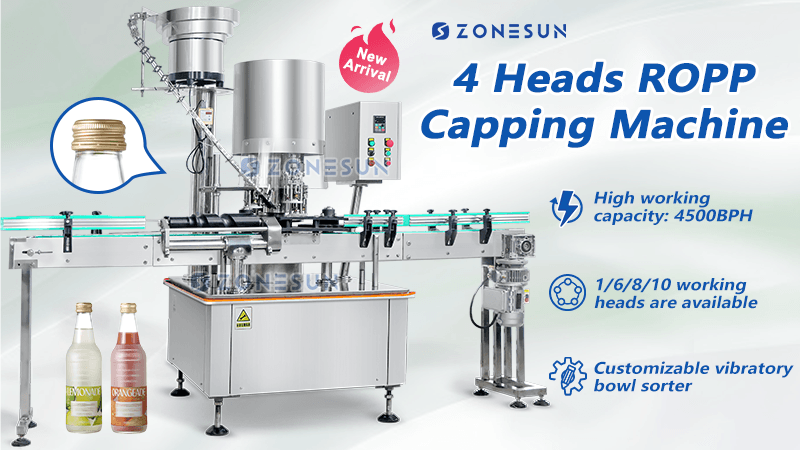
For high-volume continuous production, the ZONESUN 4 Heads ROPP Capping Machine can be a practical choice. The standard four-head version achieves a throughput of roughly 4,500 bottles hourly, and customers can opt for 1, 6, 8, or 10 capping heads to match different production capacities. It is suitable for medium- to high-volume production lines that require stable throughput and continuous operation. The main features include:
- High Output: The standard four-head configuration reaches a throughput of around 4,500 BPH (bottles per hour).
- Wide bottle compatibility: Suitable for glass bottles approximately 30–90 mm in diameter and 100–330 mm in height.
- Stable roller forming: Controlled roller pressure helps form aluminum ROPP caps consistently around the bottle neck.
- Continuous cap feeding: A vibrating cap feeder provides an organized and stable supply of caps.
- Flexible line integration: Stainless-steel conveyors and modular components can be connected with filling and labeling equipment.
What Should You Consider When Choosing a ROPP Capping Machine?
The right equipment should be selected based on the complete packaging requirements, not machine speed alone. Key factors for reference are listed as follows:
- Bottle and cap matching parameters: Verify bottle height, diameter, neck size, and aluminum ROPP cap dimensions to ensure full compatibility. Select flexible interchangeable tooling for frequent format changes, or multi-head capping machines for continuous high-volume production based on your output demands.
- Automation level and line compatibility: Consider core features including automatic cap feeding and bottle detection sensors. Confirm seamless connection with fillers, labelers, conveyors, and other supporting packaging equipment.
- Maintenance and expandability: Check the convenience of routine cleaning, component replacement, and daily maintenance. The equipment should support future production expansion to sustain stable operation and long-term value.
Conclusion
ROPP capping machine seals ROPP caps made of aluminum onto bottles. This process involves the proper positioning of the bottle, the right measurements of caps and neck sizes, appropriate pressure applied by the rollers, and appropriate speeds of the manufacturing process. Flexible automated machinery suits best where there are many kinds of bottles. Multihead machinery works well in continuous production of many bottles.
Through an assessment of the specifications of the bottles and caps, as well as the manufacturing capacity, the degree of automation required, and changeover requirements and suitability, producers will be able to select reliable and efficient ROPP capping systems. If you would like to inquire about the purchase of a ROPP capper, please contact us. As a professional packaging machinery manufacturer, ZONESUN can assess your production requirements and provide customized capping solutions.