
A gravity filling machine is a liquid filling machine that employs gravity to dispense liquid from a reservoir to bottles and other containers. With its simple working mechanism, this machine is best suited for low-viscosity fluids such as water, beverages, detergents, and chemicals. In choosing a gravity filling machine, other parameters that must be considered include fill volume, size of bottles, production rate, and automation.
How Does a Gravity Filling Machine Work?
The Working Principle of a Gravity Filling Machine
The basic principle relies on the difference in height between the product tank and the containers being filled. The liquid will be contained in a tank located above the filling valves. Upon opening the valve, gravity will make the liquid move downwards through the filling line and fill the bottle. The filling operation usually consists of four main stages:
- Empty bottles are transferred into the filling position.
- Filling nozzles align with the bottle openings.
- Valves open, and liquid flows into the containers.
- The valves close when the preset filling condition is reached.
For instance, a bottling line that can fill 500 mL bottles at 30 bottles per minute will be able to fill 1,500 bottles in 50 minutes. However, the actual productivity could be lower because of additional activities.
What Factors Affect Filling Performance?
Although the operating principle is simple, several factors can affect filling performance:
- Liquid viscosity: Thicker liquids generally flow more slowly.
- Tank liquid level: Changes in liquid height can affect flow behavior.
- Filling nozzle diameter: Influences how quickly liquid enters the container.
- Filling time: Different products may require different filling cycles.
- Bottle design: Narrow openings and unusual shapes can affect filling stability.
What Are the Main Components of a Gravity Filling Machine?
A gravity filling machine combines several mechanical and control components to create a continuous filling process.
1. Product Tank
The product tank stores the liquid before filling. This depends on the product and desired production quantity. Stainless steel is mostly utilized in the construction of product-contact parts owing to its strength, corrosion resistance, and easy-cleaning nature.
2. Filling Nozzles and Valves
Filling nozzles direct liquid into individual containers, while valves control when the flow starts and stops. Multiple nozzles can be used to increase output by filling several bottles during the same cycle.
3. Conveyor and Bottle Positioning System
The conveyor belt transfers the empty and filled bottles throughout the production process. Positioning systems help in aligning bottles below the nozzles, especially when it comes to bottles with tight necks.
4. Control Panel and Machine Frame
The control unit enables one to manipulate settings like filling time and cycles. The frame holds the tank, valves, nozzles, and other parts while enabling inspection and maintenance access.
What Liquids Can a Gravity Filling Machine Handle?
The suitability of a gravity filling machine largely depends on how easily the product flows. Low-viscosity liquids that can move consistently under gravity are generally the best candidates.
1. Water and Water-Based Products
One of the most typical applications is the use of water, as it features low viscosity and steady flow properties. Some water-based liquids or other aqueous solutions may work as well, but it is important to consider factors such as foaming, temperature, and containers since they might influence the filling process.
2. Beverages
Also, thin and fluid beverages such as water-based drinks and juices can be used for gravity filling. It is also necessary to evaluate the product for foaming and temperature sensitivity because too much foam can result in splashing and inconsistency in filling. For beverage and other free-flowing liquid applications requiring higher output, the ZONESUN 8-head Liquid Gravity Filling Machine can be a practical option. Key features include:
- Eight filling heads: Multiple containers can be filled during the same cycle to improve production efficiency.
- Time-controlled filling: Filling is controlled by filling time, while the valve can be adjusted to regulate filling speed.
- Wide liquid application: It is suitable for free-flowing liquids such as water, juice, milk, and perfume.
- Adjustable filling speed: The valve allows operators to regulate liquid flow according to application requirements.
- Compact design: Its compact structure can be useful where production space needs to be used efficiently.
3. Liquid Detergents and Cleaning Solutions
Some low-viscosity detergents and cleaning solutions can be filled using a Gravity Filling Machine. Chemical compatibility is particularly important in these applications, so product-contact materials should be selected according to the formulation. Filling tests can also help identify potential issues such as dripping or foaming.
4. Low-Viscosity Chemicals
Certain low-viscosity chemical products may be suitable when they have consistent flow characteristics. In addition to viscosity, manufacturers should consider chemical compatibility, corrosion resistance, flammability, and filling volume when selecting a filling system.
5. Other Free-Flowing Liquids
Other liquids may also be suitable if they can flow consistently under gravity. Since different products with the same application can vary in terms of their density, viscosity, and foaming, it is recommended to test them. Such factors as container design, liquid temperature, filling amount, and needed filling speed should be taken into account while selecting a Gravity Filling Machine.
What Are the Advantages of a Gravity Filling Machine?
Gravity Filling Machine has several benefits for its proper application, although it is not universal equipment and needs to be configured according to the liquid being filled, containers, and needed production rate:
- Simple operating principle: Gravity provides the primary force for liquid movement.
- Straightforward construction: Fewer pumping components can simplify the system.
- Easy operation: Filling parameters can be adjusted according to production requirements.
- Convenient maintenance: Accessible valves and nozzles can simplify routine servicing.
- Production line integration: Gravity filling equipment can be combined with conveyors, capping machines, labeling systems, and other packaging equipment.
How to Choose the Right Gravity Filling Machine?
Selecting a gravity filling machine requires looking at the complete production process rather than focusing on a single specification.
1. Consider the Liquid Characteristics
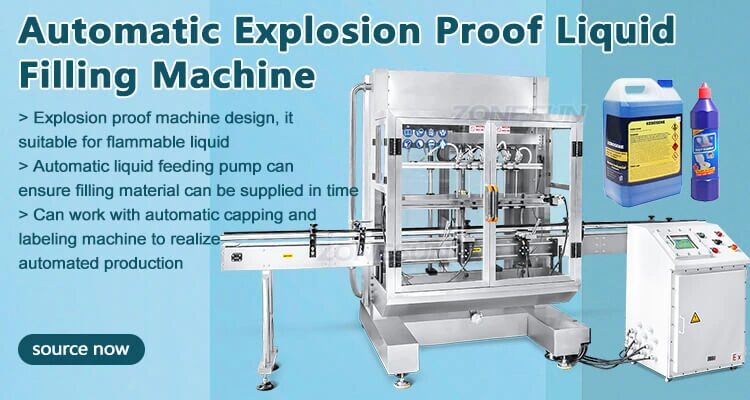
Viscosity, density, foaming properties, temperature, and chemical compatibility should all be assessed. This will assist in determining if gravity filling should be considered, as well as what materials to use in contact with the product. For flammable liquids, equipment safety should also be considered. The ZONESUN Gravity Liquid Filling Machine is designed with features for applications requiring additional safety and automation:
- Explosion-proof design: An explosion-proof design and separate explosion-proof distribution box support safer operation when handling flammable liquids.
- Automatic liquid feeding: An automatic feeding pump helps maintain a timely product supply.
- Anti-dripping design: An anti-dripping slot helps prevent residual liquid from dripping onto the conveyor and affecting the packaging process.
- Production line integration: The machine can work with automatic capping and labeling machines for a more automated packaging line.
2. Consider Filling Volume and Bottle Size
Filling requirements can vary significantly between applications. However, there is a difference between the production of 100 mL bottle lines and 5 L bottles. Factors such as bottle height, diameter, neck size, and shape must be considered because they influence nozzle positioning and conveyor design.
3. Consider Production Capacity
Determine the necessary output in bottles per minute or per hour. For instance, 1,800 bottles per hour is equivalent to an average of 30 bottles per minute. The chosen equipment must have enough capacity to take into consideration the following: cleaning time, changeover time, adjustment time, and downtime. The number of filling nozzles can also influence output per cycle.
4. Consider Automation and Cleaning Requirements
Decide on which type of system would be better suited to the manufacturing output and the amount of labor involved – either manual, semi-automatic, or fully automatic. The use of automation can help eliminate any repetitive tasks and give you more consistent production cycles. Product-contact materials, equipment accessibility, and cleaning procedures should be evaluated before purchasing the machine.
Conclusion
A gravity filling machine is a practical liquid packaging solution for products with suitable flow characteristics and production lines that require a relatively simple filling method. Its performance depends on liquid properties, nozzle design, container specifications, filling parameters, and production requirements. Before purchasing equipment, manufacturers should test the actual product and containers and define the required filling volume, production rate, and automation level. If you have any trouble with the equipment selection and filling materials, ZONESUN will be glad to help you out. You can contact us regarding your needs.