
In the liquid packaging industry, filling accuracy, production efficiency, and product appearance consistency are key factors that manufacturers focus on. This is especially important for transparent bottle packaging, where uneven liquid levels between bottles can affect the overall visual presentation and reduce customers’ confidence in product quality.
An overflow filling machine is a type of liquid filling equipment that uses a backflow control system to achieve consistent filling levels. It allows each container to reach the same liquid height, even when there are slight differences in bottle capacity. This makes it an ideal solution for products that require a neat and professional appearance.
Compared with traditional volumetric filling equipment, overflow filling technology focuses more on liquid level control. Therefore, it is widely used in industries such as alcoholic beverages, drinks, cosmetics, and other liquid products with strict packaging requirements.
1. How Does an Overflow Filling Machine Work?
The working principle of an overflow filling machine is based on specially designed filling nozzles and a liquid return system. When the liquid reaches the preset filling level, excess liquid flows back into the storage tank, ensuring every bottle maintains the same liquid height.
The complete filling process usually includes the following steps:
① Bottle Positioning
During production, empty bottles are transferred to the filling station through a conveyor system. The machine automatically positions the filling heads and connects the nozzles with the bottle openings to reduce liquid splashing and filling errors.
② Liquid Filling
Once the filling process starts, the liquid is delivered into the bottles through a pump system. The filling speed can be adjusted according to different product characteristics, ensuring smooth and stable liquid flow.
③ Excess Liquid Return
When the liquid reaches the required height, any extra liquid above the filling line returns to the liquid storage system through the backflow channel. This process effectively solves uneven filling levels caused by bottle capacity differences and is especially suitable for transparent glass bottle products.
④ Filling Completion
After filling is completed, the nozzles move away from the bottles, and the containers are transferred to the next production stage, such as capping, labeling, or packaging.
2. What Liquids Can Be Filled With an Overflow Filling Machine?
Since overflow filling mainly relies on liquid level control, it is more suitable for liquids with good flowability rather than thick or highly viscous products.
Alcoholic Beverages
The alcohol industry is one of the most common application areas for an overflow filling machine, especially for premium products packed in transparent bottles.
Typical products include:
- Whiskey
- Vodka
- Rum
- Other distilled alcoholic beverages
For example, the ZONESUN Wine Overflow Filling Machine is specially designed for beverage filling applications. It uses centrifugal pump control and customized backflow filling nozzles to achieve stable and consistent liquid levels.
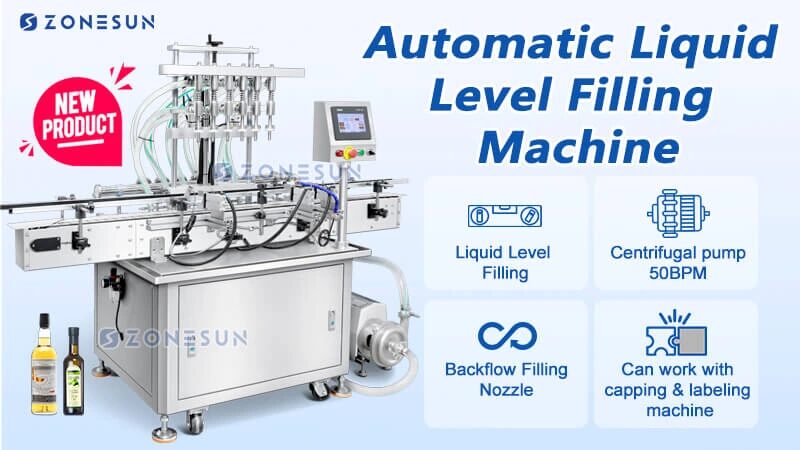
Its main features include:
- High filling accuracy: The backflow system helps minimize liquid level differences between bottles.
- Fast filling performance: Suitable for continuous production environments.
- Strong production line compatibility: It can be connected with capping machines, labeling machines, and other equipment to build automated packaging solutions.
Beverage Products
In the beverage industry, transparent bottled water, juice, and some functional drinks can also benefit from overflow filling technology.
Its advantages include:
- Maintaining consistent liquid levels
- Improving packaging appearance
- Reducing manual adjustments during production
Cosmetics and Daily Chemical Products
Some low-viscosity liquid products are also suitable for overflow filling, such as:
- Perfume
- Toner
- Hand wash
- Liquid cleaning products
These products usually focus on packaging aesthetics, making stable liquid level control an important factor in improving product presentation.
3. What Types of Overflow Filling Machine Are Available?
According to automation levels and production needs, overflow filling equipment can generally be divided into automatic machines and tabletop machines.
Automatic Overflow Filling Machine
Automatic overflow filling equipment is mainly used for large-scale industrial production.
Key features include:
- Multi-head filling operation
- Automatic bottle transportation
- Continuous production capability
- Connection with other packaging equipment
For companies handling large production volumes every day, automatic equipment can reduce manual labor and improve production consistency.
Tabletop Overflow Filling Machine
For small-batch production, product testing, or businesses with limited production space, tabletop filling equipment provides greater flexibility.
The ZONESUN ZS-DTGZ400 Tabletop Wine Overflow Filling Machine is a compact solution designed for alcoholic beverage filling applications.
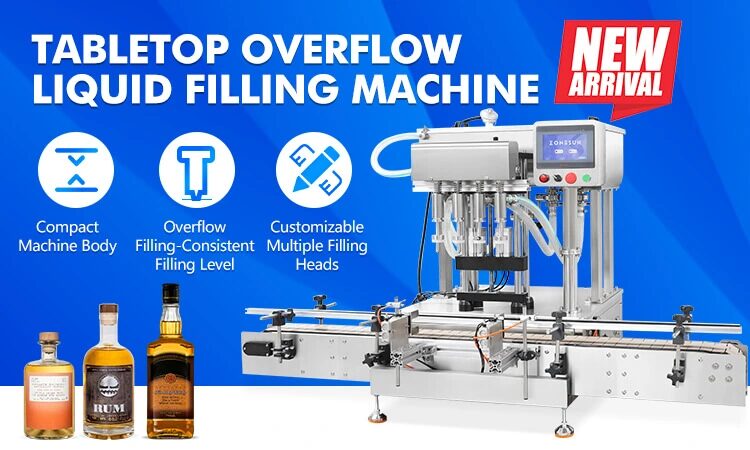
Its main features include:
- Compact Design: The tabletop structure requires less working space, making it suitable for small factories, laboratories, and businesses with limited production areas.
- Stable Liquid Level Control: The machine allows liquid to slightly exceed the preset filling line, and excess liquid is removed through the overflow process, ensuring consistent filling levels.
- Flexible Operation: Compared with large automated production lines, tabletop equipment is easier to install and operate, making it suitable for product testing, small-scale production, and growing brands.
4. How to Choose the Right Overflow Filling Machine?
When selecting filling equipment, companies should evaluate several important factors.
Liquid Characteristics
Manufacturers need to consider product viscosity, flowability, and whether the liquid contains particles.
- Low-viscosity liquids are suitable for overflow filling.
- High-viscosity products may require other filling technologies.
Production Speed
Different businesses have different output requirements:
- Tabletop equipment may suit small-batch production.
- Large-scale manufacturing is better suited to automatic filling systems.
Automation Requirements
Businesses looking to improve efficiency should consider whether the equipment can integrate with:
- Capping machines
- Labeling machines
- Conveyor systems
A complete automated solution can reduce manual intervention and improve production stability.
Conclusion
An overflow filling machine is a professional liquid filling solution that uses backflow technology to achieve precise and consistent liquid levels. It effectively solves the problem of uneven filling heights and is especially suitable for transparent packaging and products that require high visual quality.
With stable filling performance, excellent consistency, and strong adaptability for automated production, overflow filling technology has become an important solution in modern liquid packaging.
If you are looking for a suitable filling solution or have any questions about overflow filling equipment selection and applications, please feel free to contact us. As an experienced manufacturer, ZONESUN can provide professional support and customized solutions based on your production needs.