
The automatic bottle filling machine is one of the key elements in the packaging process in various food, beverage, cosmetic, pharmaceutical, and chemical industries. There are numerous materials that are employed for filling. These materials differ in their physical properties, and there is an option to configure an automatic bottle filling machine for each material with appropriate feeding and dosing systems.
There is a great difference in the materials used for bottle filling. To choose the optimal equipment for your needs, it is essential to understand the peculiarities of the materials
1. Automatic Bottle Filling Machine for Liquid Products
Liquids are probably the most popular materials for automatic bottle filling machines. Examples of products made from liquids include drinking water, juice, cooking oil, detergents, lotions, and disinfectants. Since there are liquids of various viscosities and flow characteristics, it is necessary to match the filling method and machine settings to the product.
Popular Liquid Filling Methods
- Pump filling – uses pumps to fill liquid containers. Suitable for many liquids with different flow characteristics.
- Piston filling – uses pistons to measure the volume of liquid that is dispensed in each cycle. It is a good option if you need a precise filling quantity.
- Servo-controlled filling – the process of filling is controlled by a servo system that regulates filling movements and operating parameters.
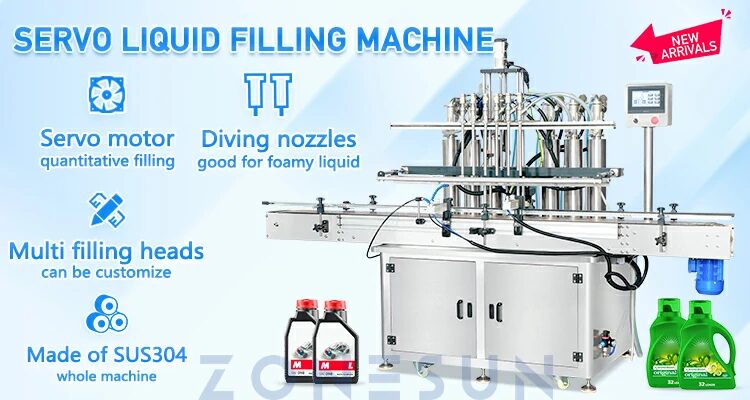
As an example of filling machines with several filling heads, one can refer to the ZONESUN 6-head servo liquid filling machine, which has six filling heads working on the same machine for processing several bottles at once. This configuration is good if you need to have a relatively high-speed production line.
What Factors Influence the Liquid Filling Process?
The liquid filling machine operation can be affected by different variables:
- Viscosity – water and alcohol flow differently from detergents, syrups, and other thicker liquids.
- Filling accuracy – the tolerance should correspond to the capacity of the bottles and requirements of the product.
- Foaming and dripping – some foamy liquids require diving nozzles and some special nozzle design to reduce dripping.
- Speed – the number of filling heads, volume of the filling, and bottle conveyor speed will affect it.
2. Automatic Bottle Filling Machine for Paste and Cream
Viscosity of pastes and creams is usually high, and these products can move slowly and stick to the inner surface of pipes and filling nozzles. Typical examples of this product category are facial creams, hand creams, lotions, gels, toothpaste, and various types of food sauce.
Why Do Paste Filling Require Specific Equipment Configuration?
Viscous substances experience greater resistance to transportation and dispensing in comparison with water-like liquids. Low supply pressure can lead to low filling speed, insufficient filling amount, or even material residues.
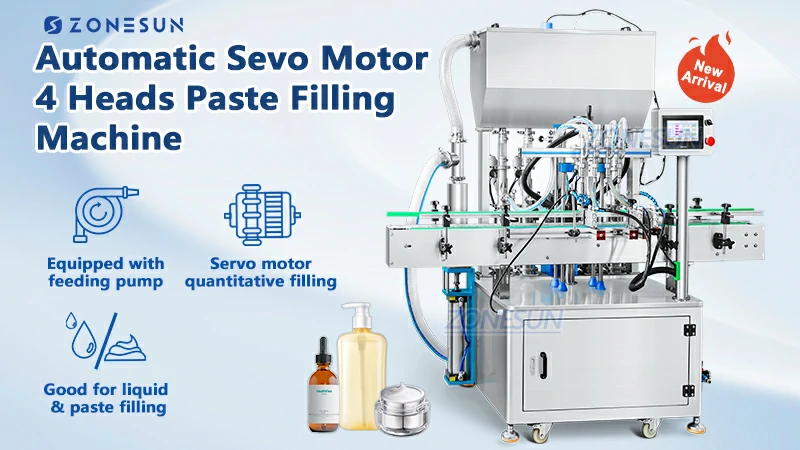
That is why paste filling machines use piston pumps or other positive-displacement pumps. The type of pumping system depends on material viscosity and filling needs.
One of the possible equipment options for paste filling is ZONESUN’s cosmetic filling machine, which is applied in the manufacturing process of creams and lotions. The configuration of this equipment depends on the properties of the material, container capacity, and required filling volume.
Requirements for Paste Filling
- Stabilization of material supply;
- Minimum material residues (nozzles must correspond to the material to reduce stringing, dripping, and contamination of the bottle opening);
- Ease of cleaning the parts contacting the material; it is especially important when manufacturers change their products;
- Stability of the filling volume; the filling volume can be controlled by setting the required piston stroke or dose.
The viscosity of lotion can be very low in comparison with thick facial cream. That is why the equipment choice should be based on the properties of the substance rather than on product name.
3. Automatic Bottle Filling Machine for Granular Products
Granules include a wide variety of solid particles having different sizes, shapes, and weights. Typical examples of granules include nuts, candies, cereals, seeds, tablets, and plastic pellets.
In contrast to the liquid filling process, granule filling requires controlling the amount of the solid material inside the bottle and protecting fragile particles from impact.
Common Granule Filling Techniques
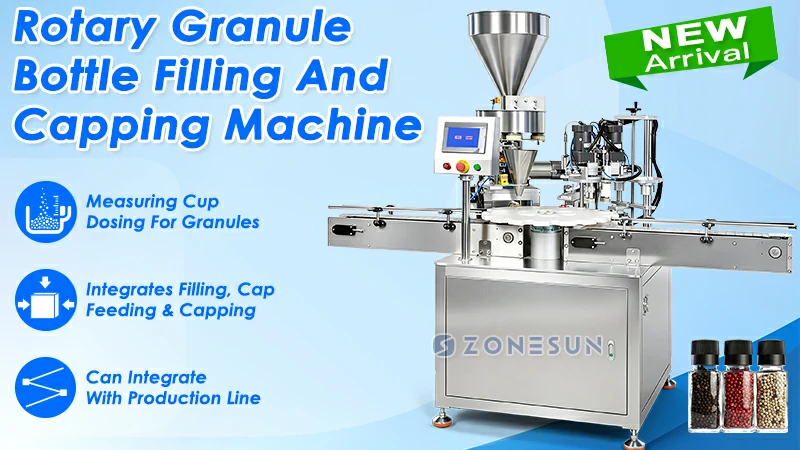
- Volume cup filling – this technique uses the fixed volume of the substance as a means of controlling the amount of material to be dispensed. It is suitable when the particle sizes and the bulk density of granules are stable.
- Weighing filling – this method uses the load cells for measuring the weight of the dispensed material. It is suitable when there is a requirement for the exact weight of the material in each bottle.
- Counting filling – this technique is used for dispensing a specific number of individual pieces of granules. This method is usually applied for tablets and capsules with relatively uniform sizes.
For granular product manufacturers, ZONESUN’s ZS-AFC51M bottle grain filling and capping machine is an appropriate equipment option allowing for carrying out both operations at once.
Factors Affecting Granule Filling Process
- Particle sizes;
- Protection of product integrity (for fragile products such as nuts and candies, the feeding height and minimum product impact are needed);
- Consistency of the granules’ weight (weighing system is recommended for granules with significant difference in weight);
- Speed of discharge.
4. Automatic Bottle Filling Machine for Powder Products
Powder filling technology finds wide application in food processing, healthcare, pharmaceutical and chemical industries. There is a range of commonly filled products – milk powder, coffee powder, protein powder, flour, spices and industrial powders.
The major difficulties appear to be associated with variations in the bulk density, particle size, and flowability. Fine milk powder tends to produce dust during dispensing; moisture-sensitive powders may create lumps and affect the feeding process.
How does Auger Filling Control Powder Dosage?
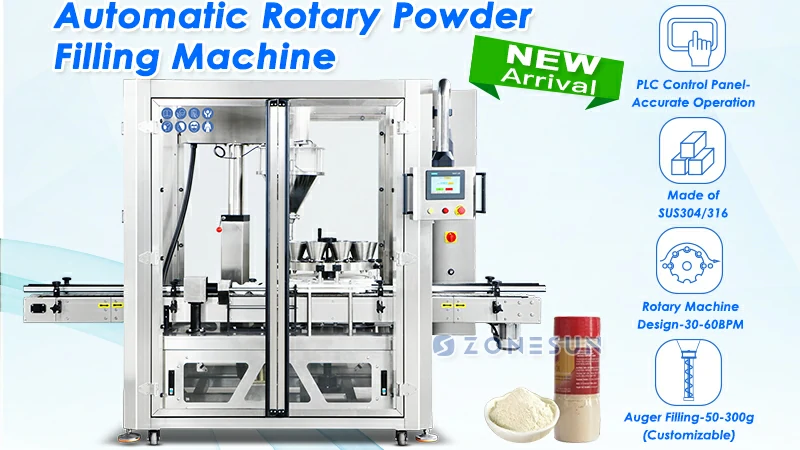
Auger filling is one of the most widespread ways of dispensing powder into bottles. The rotating screw drives powder towards the filling nozzle of the machine. The machine regulates the rotation of the screw or other dosing parameters in order to provide proper dosage.
This approach helps to regulate operating conditions depending on powder properties and filling needs.
For instance, ZONESUN’s automatic rotary bottle powder filling machine is based on the rotary bottle handling system and is intended for the continuous dispensing of powder. It is a solution for those production areas where repeated filling operations are needed. Performance is subject to powder density, flowability, and the dosing system chosen.
Main Points for Powder Filling Process
- Bulk density: loose and compacted powders differ in density and affect the amount of weight that would be produced by the same volume of the powder;
- Dust control: fine powders might require dust removal connections, a closed feeding system, and special nozzles;
- Dosing precision: screw speed, screw pitch, and powder supply affect filling process results;
- Anti-bridging design: moisture-absorbent or lumpy powders require special hopper design or feeders.
Conclusion
Liquids, pastes, powders, and granules vary in terms of fluidity, dosage requirements, and filling properties. Selecting an Automatic Bottle Filling Machine is not only about recognizing the product type. The following factors should be considered too: the product’s viscosity, bulk density, particle size, filling accuracy, and output rate.
The company ZONESUN provides automatic bottle filling machines for various types of materials, thus making it possible for manufacturers to choose the machine that corresponds to the packaging process. If you have any questions concerning the selection of the filling system for your products, feel free to contact us.