
Bottling is the last barrier to ensure good wine quality. After the process of fermentation and aging of the wine, making sure it gets into a bottle without excess oxygen intake, foaming, or poor filling levels protects your brand image in the retail store. No matter whether you own a vineyard or operate a big industrial cellar, choosing a suitable wine filling machine directly affects your labor costs, losses, and production volumes. Buyers find themselves having to choose between two types of machines: tabletop and floor-standing.
1. What Is a Tabletop Wine Filling Machine?
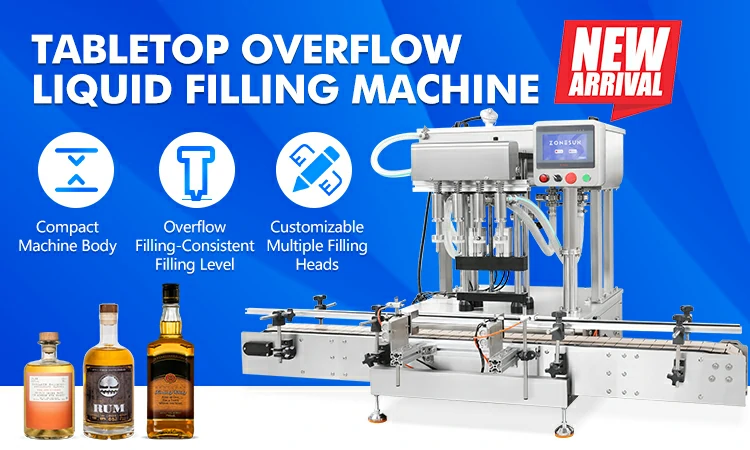
The tabletop wine filling machine is a compact, bench-mounted bottling machine designed for small wineries, special releases for tastings, testing laboratories, and new brands. Such an automatic machine does not take up any space on the floor and does not require complex utility installations.
- Filling Process: The vast majority of benchtop machines use gravity or overflow technology, which guarantees filling glass bottles of different internal volume capacities with wine to the same level.
- Small Size and Hardware: For example, the ZONESUN ZS-DTGZ400 tabletop wine overflow filling machine has four filling nozzles, a capacity of 70L, a power of 150 W, an air pressure of 0.4-0.6 MPa, and can handle bottles up to 1,500 ml in diameter of 50 mm-80 mm.
- Flexible Batch Change and Maintenance: Since the containers are put in manually or using a short conveyor, it is easy to change varieties and clean the fluid flow line.
2. What Is a Vertical Wine Filling Machine?
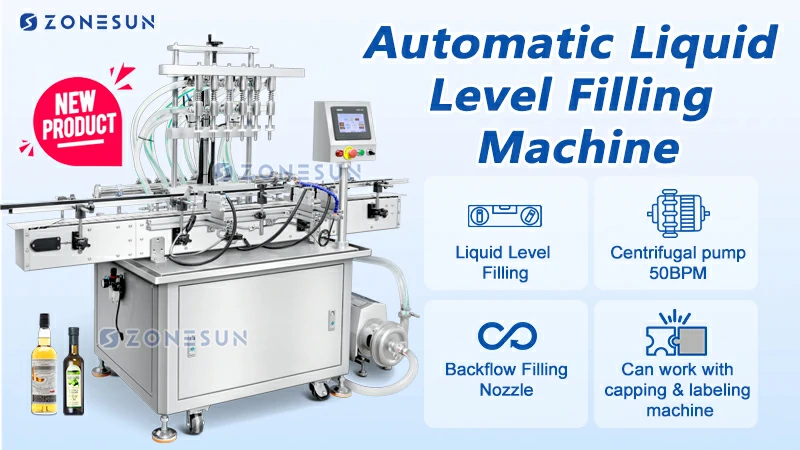
Unlike tabletop machines, a vertical wine filling machine is a floor-standing industrial machine designed for large-scale bottling. Usually, such machines have heavy-duty construction with 304 or 316 stainless steel frames and provide high-speed processing of the products.
- Precise Dosing and Automation: Vertical filling machines use programmable logic controllers (PLCs), automatic bottle indexing, and different filling technologies (piston, gravity, or negative pressure) suitable for bottling different types of wine.
- Large Specifications of Industrial Machines: For example, the ZONESUN ZS-VTZL100 runs at a total power of 2.5 kW and provides ±2 ml accuracy in bottling different rigid bottles from 100 ml to 750 ml, with diameters of 30 mm to 110 mm and heights of 310 mm.
- Complete Line Integration: Unlike tabletop machines, vertical wine filling machines are connected to upstream and downstream machines (rinser, corker, capper, etc.)
3. Tabletop vs. Vertical Wine Filling Machine: What Are the Differences?
Comparing concrete engineering specifications reveals how differently these two machine classes perform on an active production floor. Looking at representative models side by side clarifies the trade-offs between footprint, speed, and bottle compatibility:
| Comparison Metric | Tabletop Wine Filling Machine (e.g., ZS-DTGZ400) | Vertical Wine Filling Machine (e.g., ZS-VTZL100) |
| Machine Dimensions & Layout | Approx. 1810 × 1040 × 1000 mm; sits on a standard workbench or low stand | Approx. 1906 × 880 × 1702 mm; independent floor-standing industrial frame |
| Rated Production Speed | Approx. 12–20 bottles/min (720–1,200 bottles/hour, volume-dependent) | Approx. 50 bottles/min (up to 3,000 bottles/hour in continuous operation) |
| Fill Volume & Control | Up to 1,500 ml per bottle; overflow design ensures uniform cosmetic fill levels | Recommended 100–750 ml for rigid bottles; ±2 ml volumetric accuracy |
| Compatible Bottle Specs | Diameter: 50–80 mm; Height: 200–300 mm; Neck opening: 20–35 mm | Diameter: 30–110 mm; Height: 100–310 mm; Neck diameter: 25–40 mm |
| Power & Utility Needs | 110/220V, 150W low energy draw; requires 0.4–0.6 MPa compressed air | 2.5 kW industrial power supply built for sustained, multi-shift duty cycles |
Beyond raw specifications, the operational divide comes down to labor allocation and changeover agility. A tabletop wine filling machine requires hands-on bottle handling, keeping upfront capital low while capping hourly output. Conversely, a vertical wine filling machine demands higher initial investment and floor planning, but dramatically lowers per-bottle labor costs once daily production scales past a few thousand units.
4. How to Choose the Right Wine Filling Machine for Your Production Needs?
Choosing the correct filling system means taking into account what is currently being produced in terms of schedules, bottle variety, and restrictions of a facility, rather than overinvesting in excessive filling capacity.
When to Choose a Tabletop Wine Filling Machine
- Small-Scale Boutique Winemaking Operations: If your annual output doesn’t exceed a few thousand cases, and you bottle several times per month at a rate of 12-20 bottles per minute, manual labor will be convenient and won’t demand additional investments in heavy machinery.
- Bottles of Different Volume: Facilities that produce both standard 750 ml Bordeaux bottles and 1,500 ml Magnum reserve wines will appreciate high capacity of benchtop overflow systems.
- Financial Restricting Factors: Startup companies operating from leased wineries in an urban environment would value being able to use a 150W tabletop system that can be connected to the mains without requiring costly three-phase power.
When to Choose a Vertical Wine Filling Machine
- Mass-Scale Commercial Wineries: When wholesale contracts imply daily shipments of pallets of bottles, a vertical filling machine working at 50 bottles per minute solves bottling problems.
- Automatic Packaging Lines: When it comes to linking automatic bottle unscramblers, nitrogen purging, corking, and rotary labelers in a single-line process, vertical chassis with appropriate conveyor height should be used.
- Various Retail Bottles: Wine producers who need to fill bottles in sizes ranging from 100 ml sampler bottles to 750 ml retail bottles (30-110 mm diameter bottles) will appreciate fast and accurate ±2 ml dosing.
Conclusion
Both tabletop and vertical filling machines suit different bottling purposes. While a tabletop wine filling machine is a cost-efficient option for small and medium craft producers, a vertical wine filling machine ensures higher filling speeds and ±2 ml accuracy required for mass-scale commercial distribution. Matching your current batch sizes and bottle sizes with future two-year plans will show you what filling system you need.
Feel free to contact us to learn more about choosing and configuring your ideal wine filling machine for the range of bottles you produce. The engineering team at zonesun88 will be glad to help you evaluate your line needs.