
Selection of appropriate filling and capping machines is essential for manufacturers using liquid products in vials. A vial filling and capping machine has to correspond to the dimensions of the vials, their filling volumes, the properties of the product used, necessary output levels, and production conditions. Selection of the equipment based on filling speed alone can lead to issues related to accuracy, compatibility, cleanliness, or potential modifications in production.
Therefore, filling and capping equipment has to be selected within the context of the overall packaging process rather than as a separate equipment item. Matching technical specifications to the capabilities of the selected machine will help manufacturers achieve stable operation and maintain consistent product quality.
Why Is Choosing the Right Vial Filling and Capping Machine Important?
Match the Machine With Production Requirements
Differences in production requirements between small-scale batch manufacturing and industrial-scale production have to be considered. A lab or contract manufacturer will need flexible equipment capable of handling several sizes of vials, while the larger production line will require continuous operation and high output. The required batch size, working hours, vial dimensions, filling volume, and number of product changes should be identified before equipment selection.
A vial filling and capping machine should also leave enough capacity for expected production growth. For example, if the current rate of production is 2,000 vials per hour but it will be increased to 3,000–4,000 vials per hour, then equipment selection with low capacity will lead to problems in the future.
Balance Filling Accuracy, Speed, and Product Quality
A high level of speed is not necessarily equal to good performance. Too fast filling will lead to splashing, foaming, dripping, and inaccurate dosing, especially when dealing with low-viscosity liquids. On the other hand, very slow speed decreases productivity without significant benefits in terms of quality.
While analyzing the vial filling and capping machine, it is important to take into account the connection between dosing precision, speed of production, and properties of the product. In case there is a need for precise dosing, it is possible to choose an accuracy of ±1%, depending on the product and process. Capping precision should also be taken into account since bad capping can affect the safety of the product and quality of packaging.
What Factors Should You Consider When Choosing a Vial Filling and Capping Machine?
Vial Size and Container Compatibility
Vial dimensions can vary in diameter, height, filling volume, and cap size, so equipment must match the containers used in production. A mismatch can cause unstable positioning, filling errors, or problems during capping. When choosing a vial filling and capping machine, manufacturers should check the supported vial dimensions and determine whether molds, filling components, or cap-handling parts can be customized for different formats.
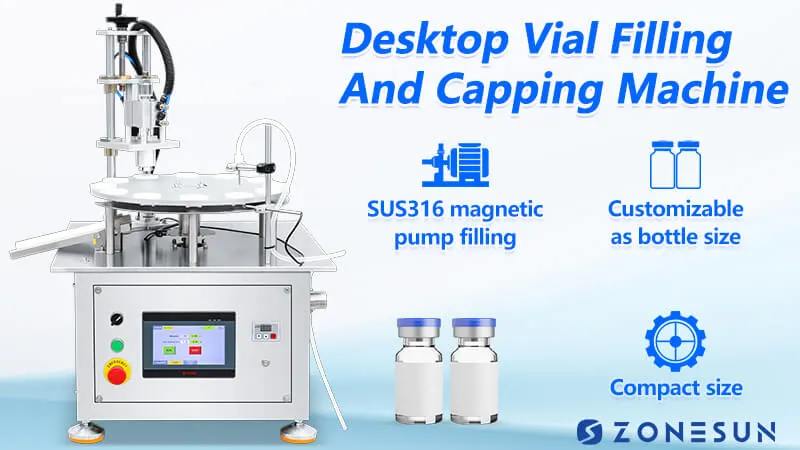
For manufacturers handling small vials with different specifications, ZONESUN’s Desktop Rotary Vial Filling Capping Machine offers flexible container compatibility. The ZS-AFC1CB supports 5–30 mL filling volumes, vial diameters of φ15–50 mm, and vial heights of 30–80 mm. Its main features include:
- Customizable molds: Help accommodate different vial sizes and shapes.
- SUS316 magnetic pump: Provides hygienic and accurate liquid filling.
- Rotary table: Integrates filling and capping into one continuous cycle.
- Customizable cap compatibility: Can be adapted to different cap specifications.
- Compact desktop design: Requires about 750 × 750 × 800 mm of packaging space.
 Filling Volume and Accuracy
Fill volume is another critical factor, as it determines the amount of product filled in each container. Likely,t the filling equipment suitable for 2–10 mL fill volumes will be inappropriate for use in products with 50-100 mL fill volumes. The selected filling system should cover the required volume range while maintaining stable dosing performance.
Different filling technologies are suitable for different liquids. Piston pump machines are appropriate for the precise dosing of liquid products; a peristaltic system can also be considered when controlled product contact is required. When choosing a vial filling and capping machine, one should analyze the filling range, the dosing principle, the precision of the machine, and the adjustment method.
Production Speed and Capacity
Production speed should match the actual output required by the production line. The maximum speed of the machine is 60 bottles per minute, which gives a capacity of 3,600 vials per hour. However, actual output is lower than theoretical due to various reasons such as feeding, filling, capping, material changeovers, and stopping of production. Therefore, when selecting a vial filling and capping machine, manufacturers have to take into consideration realistic output.
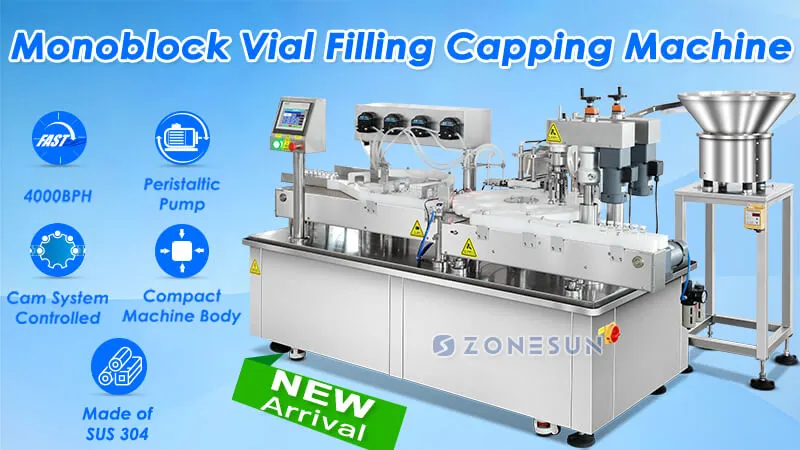
For manufacturers that need to improve output while keeping filling and crimping in one process, separate packaging operations can increase handling time and make production less efficient. ZONESUN’s 4 Heads Vial Filling Capping Machine addresses this need with an integrated design. Its key features include:
- Four filling nozzles: Allow multiple vials to be filled simultaneously.
- Servo peristaltic pump: Provides controlled and consistent liquid filling.
- About 4,000 BPH: Supports continuous vial packaging at a practical production rate.
- ±1% filling accuracy: Helps maintain consistent filling volumes.
- Filling and crimping in one machine: Reduces the need for separate processing equipment.
- Customizable filling range: Can be configured for different filling requirements.
Filling Material and Product Characteristics
The physical properties of the product directly affect filling performance. Viscosity, tendency to foam, thermal properties, presence of particles, and chemical incompatibility have to be taken into consideration during selection of the vial filling and capping machine. Different liquids like water, oils, syrups, gels, and suspensions require different filling mechanisms and pumps.
Compatibility with the product is necessary since all components have to withstand corrosion and contamination. Before purchasing equipment, manufacturers should provide product samples or detailed specifications when possible. This helps determine whether the selected pump, filling path, and contact materials are suitable for stable and consistent filling.
Automation Level and Operation Requirements
Automation needs will vary depending on batch size, workforce availability, and process complexity. Semi-automatic equipment will be suitable where manual vial loading is feasible, while fully automatic machines can incorporate feeding, filling, stoppering, capping, and discharging of the products.
When selecting equipment, manufacturers must look at the control system, recipes, sensors, alarms, safety features, and ease of adjustment. An easy-to-use control system helps monitor important process parameters, while recipe management on a vial filling and capping machine can save time during future setups.
Cleaning, Maintenance, and Changeover Requirements
Cleaning and maintenance needs must be determined before the equipment installation, and not after problems have already occurred. Product contact parts must be easily cleanable, while other parts are removable for inspection and repair. The required cleaning method should also be compatible with the product and production environment.
Changeover time is another important consideration. If a facility changes vial sizes several times per day, a machine requiring lengthy mechanical adjustments can reduce overall efficiency. A vial filling and capping machine with straightforward format adjustment and accessible components can help reduce downtime.
Conclusion
The selection of equipment should not only be based on the maximum fill rate. An appropriate vial filling and capping machine should be compatible with the vial type, fill volume, product properties, accuracy, throughput, automation, and maintainability. The manufacturer should take into account its future needs as well.
The testing of the equipment using real vials and products will help determine the ability to achieve consistency in filling and capping and proper changeover. If you are comparing filling and capping solutions and need help selecting a suitable configuration, you can contact ZONESUN for further information and professional assistance.