
Precision in positioning of the label is crucial for many industries, such as the pharmaceutical industry and cosmetic product packaging. Just a couple of millimeters’ deviation from the right position may have an effect on how the product looks, how easy it is to scan a barcode, or it can be even discovered during further inspection. Thus, the accuracy of the Vial Labeling Machine is not determined by just one component of the device, but rather by multiple factors.
1. How Do Vial and Label Characteristics Affect a Vial Labeling Machine?
The physical characteristics of both the vial and label provide the foundation for accurate application. Even a precisely adjusted Vial Labeling Machine may produce inconsistent results if the containers or labels vary significantly from the required specifications.
Vial Size and Shape
First of all, vials themselves vary in diameter, height, shoulder, and surface design. Any change in the diameter of the vial may affect the contact point of the container and the labeling component. Vials with a cylindrical shape are usually labeled precisely due to the predictable surface of the object that can be easily rotated.
For instance, if the vials used in one production line have diameters varying from 10 to 30 mm, then the device may need different guides or operating parameters to achieve the same precision of label positioning.
Label Size and Material
Dimensional features, thickness, adhesive characteristics, and backing material may influence the feeding and application process. Overly flexible labels tend to become wrinkled during application, whereas excessively rigid materials might not conform well to the vials’ curved surfaces. Compatibility of the label length to vial circumference is a critical issue. The proper ratio between them should be observed for wraparound labeling applications. Label dimensions have to match the vial diameter and the necessary overlap/gap.
Surface Condition and Cleanliness
The vial surface has to be clean, dry, and free of dust, oil, moisture, and any other contaminants. Contamination may reduce adhesive contact and lead to lifting, bubbling, and partial detachment of the label. In case of pharmaceutical labeling applications, consistent container handling is especially crucial since minimal contamination may affect the adhesion and inspection processes.
2. How Does Machine Configuration Affect a Vial Labeling Machine?
The configuration of a Vial Labeling Machine determines how accurately each vial is positioned before and during label application. Components that control detection, alignment, and container movement must work together rather than operate independently.
Label Positioning and Alignment
The labeling head must be correctly aligned with the vial path. Small deviations in the label dispensing position can become visible when the label is applied to thousands of containers. Guide rails, dispensing plates, and other positioning elements should be adjusted depending on the vial dimensions to keep the necessary distance between the edge of the label and the reference point on the vial.
Sensor Accuracy and Detection
Sensors will determine when a vial is at the labeling position or whether there are any gaps between the bottles or labels. Sensor positioning and sensitivity should therefore be checked during setup. For high-speed production, even a small timing error can produce noticeable placement variation across a large batch.
Vial Handling and Conveyor Stability
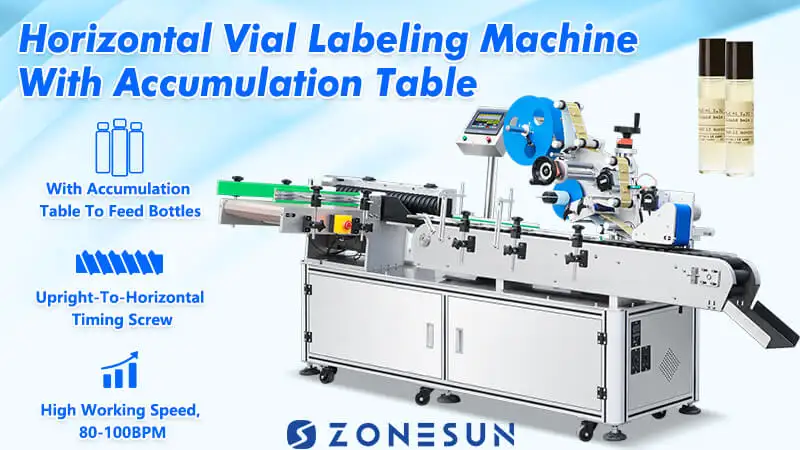
Stable container movement is essential for consistent labeling accuracy. If vials rotate, tilt, or shift while passing the labeling station, the label may be applied unevenly. A stable conveying and positioning system helps keep each vial on the correct path. For small round vials that need stable handling at higher speeds, ZONESUN’s ZS-HTB832 High Speed Horizontal Vial Labeling Machine is a good choice, featuring:
- Timing screw conveyors smoothly transfer bottles from an upright to a horizontal position before labeling.
- 80–100 BPM capacity supports continuous high-speed vial labeling.
- ±1 mm labeling accuracy helps maintain consistent label placement.
- Bottle accumulation table supports continuous feeding and stable material flow.
3. Which Process Parameters Affect Vial Labeling Machine Accuracy?
After the equipment is configured, operating parameters can determine how consistently labels are applied. The correct settings depend on the vial format, label material, adhesive characteristics, and required production rate.
Labeling Speed and Production Rate
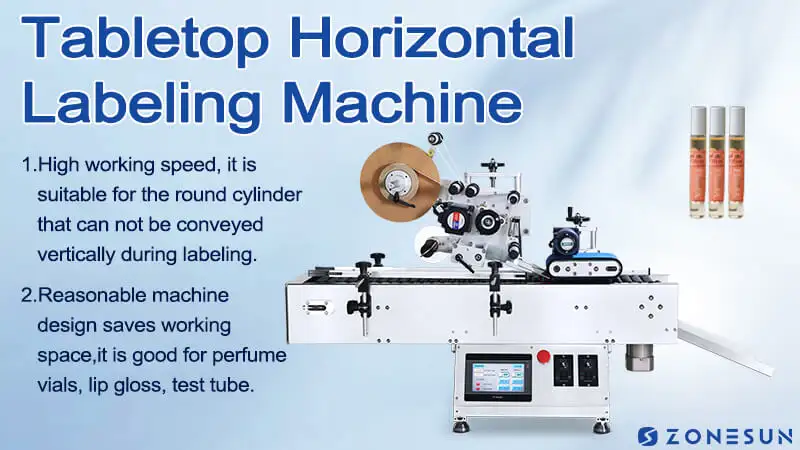
Labeling speed also affects accuracy because the labeling mechanism needs enough time to apply each label consistently. Running beyond the suitable production rate may increase positioning variation, especially when handling small containers. For applications that require a controlled labeling speed, ZONESUN’s Tabletop Horizontal Labeling Machine is a good choice, featuring:
- 30–50 bottles/min speed provides a controlled production rate.
- 10–30 mm container diameter supports small cylindrical containers.
- Up to 150 mm container height accommodates different container sizes.
- Horizontal labeling design is suitable for products such as vials, test tubes, and lip gloss containers.
Label Feeding and Tension Control
Consistent feeding of the labels is vital to ensure consistent positioning. Labels that have too much tension tend to deform, whereas those with less tension might end up being dispensed incorrectly. The Vial Labeling Machine should maintain stable label-web tension throughout continuous operation. Roll quality, backing material, adhesive characteristics, and unwind settings should also be considered when troubleshooting feeding problems.
Vial Spacing and Positioning
Consistent spacing allows the sensor and labeling mechanism to respond at predictable intervals. If vials are too close together or arrive at irregular distances, the system may experience timing errors. An appropriate infeed system can separate containers before they reach the labeling station. This creates a more stable operating rhythm and helps maintain consistent label placement.
4. What Production Conditions Affect Vial Labeling Machine Accuracy?
Production conditions can also influence labeling performance, especially when labels and adhesives are sensitive to environmental changes. Maintaining stable conditions can make machine adjustment more predictable.
Temperature and Humidity
Temperature can affect adhesive viscosity and label flexibility, while humidity may influence the backing material and adhesive performance. Large environmental changes can therefore lead to differences in label feeding or adhesion. Manufacturers should follow the storage and operating conditions specified for their label materials and adhesives. Keeping production conditions relatively stable can reduce unnecessary variation.
Dust and Contamination Control
Contamination with dust and other particles might be an issue for the sensors and the labels. This is especially the case in the pharmaceutical industry, where contamination control is one of the most crucial aspects of manufacturing processes. Proper cleaning of the labeling area and storage of the materials can prevent this problem. The labels should stay protected until use.
Label Position Inspection and Error Detection
Quality inspection provides the final check on whether the Vial Labeling Machine is producing consistent results. Operators can measure label height, horizontal position, rotation, and adhesion according to the product specification.
For automated lines, vision inspection systems can identify misplaced, missing, damaged, or incorrectly oriented labels. A suitable inspection system may check every vial rather than relying only on periodic manual sampling, allowing defective products to be removed before they proceed to the next packaging stage.
5. Conclusion
Accuracy in the operation of the Vial Labeling Machine is affected by several interrelated issues, such as the size of vials, the characteristics of labels, the settings of the machine itself, its mode of operation, mechanical condition, and the surroundings where the process takes place.
For manufacturers handling different vial sizes or label formats, the machine should be configured according to specific product and production requirements. With proper setup and preventive maintenance, labeling accuracy can remain stable during continuous production. If you have any questions about vial labeling applications or machine configuration, feel free to contact ZONESUN for further information.