
Liquid filling equipment for the food and beverage, pharmaceuticals, chemical, and daily chemical products industry is the answer to achieving continuous production and product quality consistency. As the level of market competition increases and customers become more demanding regarding stability, precision, and automation levels of liquid filling equipment, manufacturers are also paying more attention to these aspects. Moreover, the selection of a suitable liquid filling machine depends on the type of liquids being processed—that is, liquids with different viscosities and compositions.
1. Gravity Filling Equipment
- Working Principle: The gravity filling machine uses the weight of the liquid, which flows from the holding tank into containers as soon as the valve opens. The filling quantity, depending on either the opening of the valve or the level of the liquid, ensures a mechanical system with a low failure rate, which is appropriate for continuous production.
- Application Range: This type of liquid filling equipment is suitable for filling low-viscosity liquid products like water, juice, and alcohol. This machinery finds wide application in food industries where products are filled in containers at a fast pace due to high demand.
- Equipment Features: The equipment is relatively low in cost, operates easily, and is serviced readily, but the liquid properties must be stable, and the equipment is unsuited for highly viscous, foamy, or particulate liquids.
2. Pressure Filling Equipment
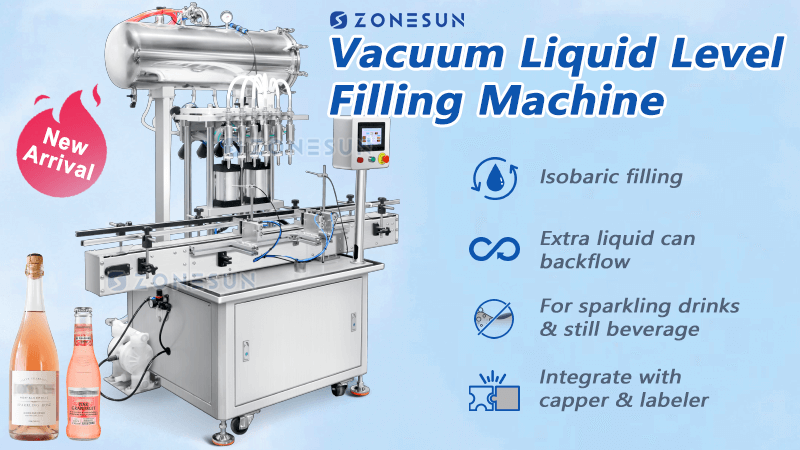
- Working Principle: Pressure filling equipment applies constant pressure to the liquid tank or filling system, forcing the liquid into containers at a controlled speed. The filling process is typically enclosed, helping maintain consistent flow and reduce external interference.
- Application Range: The liquid filling equipment is brilliant for carbonated drinks, beers, and gas-containing liquids, as it offers the potential to preserve the gas during filling.
- Equipment Features: Pressure-filling machines allow for very high fill rates. The stability of pressure filling machines is very strong, and they can be used on completely automated, high-output lines. They have been designed with more complicated systems and higher upfront and maintenance costs.
3. Piston Filling Equipment
- Working Principle: The reciprocating motion of the piston is utilized by the piston filler to draw liquid into a cylinder and dispense exactly a fixed volume in each container. Each stroke is consistent, hence yielding a high level of filling accuracy.
- Application Range: The liquid filling equipment is suitable for highly viscous liquids, thick pastes, and products containing particulates, one would immediately think as sauces, honeys, creams, shampoos, and various pharmaceutical formulations.
- Equipment Features: They provide good accuracy and repeatability with little drip or stringing, but the more complex design requires extensive cleaning and more frequent maintenance between products.

4. Pump Filling Equipment
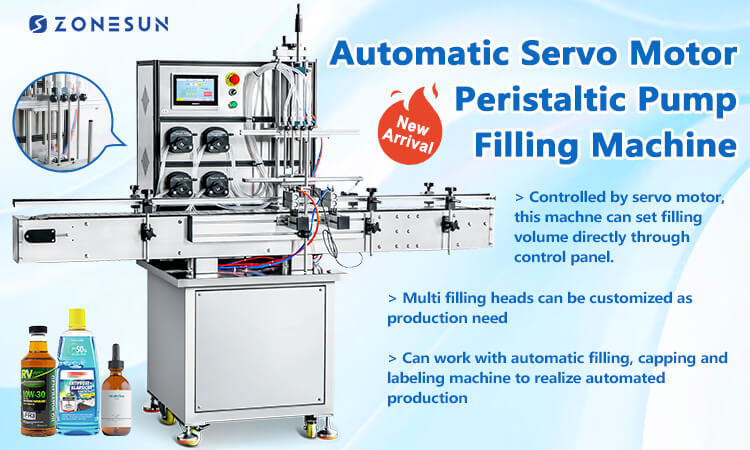
- Working Principle: The filling machines include gear, peristaltic, or rotor pumps to transfer liquid into the containers by means of controlled flow. Filling volume is adjusted by regulating pump speed and filling time.
- Application Range: This liquid filling equipment can handle a wide range of viscosities, from thin to moderately thick liquids, and is particularly suitable for foamy, corrosive, or hygiene-sensitive products used in pharmaceutical, food, and chemical industries.
- Equipment Features: Pump filling machines have high flexibility and adaptability in accommodating various sizes of containers and various products. These machines are ideal for multi-product processing lines or small-batch processing.
5. Vacuum Filling Equipment
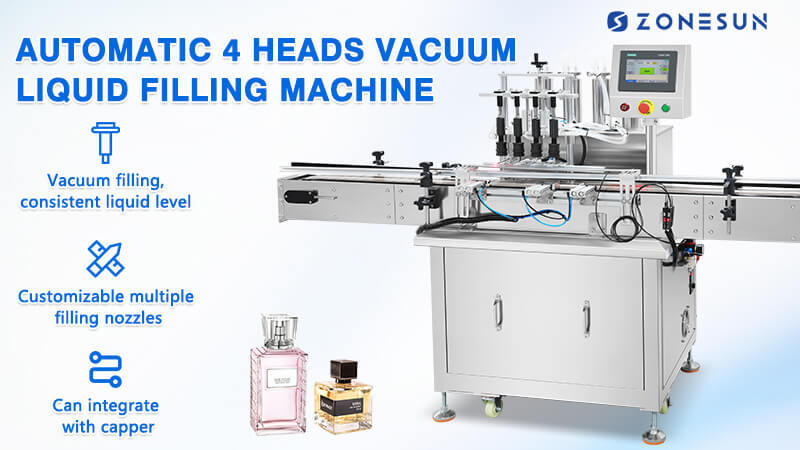
- Working Principle: The vacuum filling apparatus generates negative pressure within the container so that the liquid is suctioned inside up to a desired level. The result is equal filling of all vessels.
- Application Range: These liquid filling equipment are generally employed for the filling of glass bottles and are suited for products that have a need for a uniform volume, perfumes, condiments, and cosmetics, among others.
- Equipment Features: Vacuum fillers produce a clean and visually uniform fill appearance, but they require rigid containers with good sealing properties and are not suitable for flexible packaging.
6. Automatic and Semi-Automatic Liquid Filling Equipment
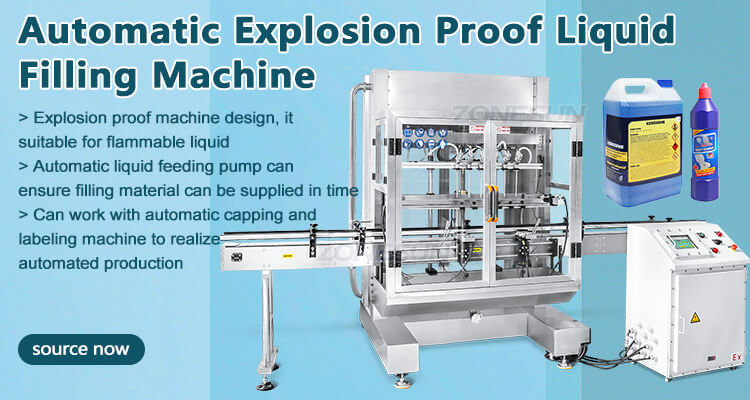
- Semi-Automatic Equipment: Semi-automatic liquid filling equipment requires manual container placement and active operator involvement during the filling process. This type of equipment is well-suited for small to medium-sized businesses, startups, or production lines with frequent product changes. It offers greater operational flexibility, allows quick adjustments for different container sizes or filling volumes, and requires a relatively low initial investment, making it an ideal choice for companies with limited budgets or customized production needs.
- Fully Automatic Equipment: Fully automatic liquid filling equipment undertakes the tasks of bottle feeding, positioning, filling, and capping in a very coordinated and continuous manner. The advantage of this equipment lies in its minimized need for manual assistance, which leads to enhanced production efficiency and reduced production expenses, besides precise filling volumes. These machines could be most effectively utilized for handling standardized production in bulk quantities, wherein key areas of output and production efficiency need consideration.
Conclusion
Different types of liquid filling equipment vary in working principles, suitable liquid characteristics, and production efficiency, each serving specific application needs. When selecting filling equipment, companies should carefully evaluate their product properties, packaging formats, production capacity goals, and budget. As a professional liquid filling equipment manufacturer, ZONESUN is committed to providing stable, efficient, and customized filling solutions that help businesses improve productivity and maintain consistent product quality. If you are looking for reliable liquid filling equipment, feel free to contact us for expert guidance and technical support.