
The integrity of the sealing operation in modern medicine and biomedicine manufacturing is crucial for the quality, purity, and safety of the end product. The vial capping machine is an important component used to seal vials using aluminum or aluminum-plastic caps. With the advancement of automation technology, it has evolved from manual operation into a highly precise and efficient automated system that ensures consistent sealing quality while significantly improving production capacity.
Basic Working Principle
Bottle Feeding and Positioning System
In the initial stage of production, the vial capping machine transfers the filled vials to the capping area using the automatic bottle feeding mechanism. Usually, the conveyor system consists of either stainless steel belts or star wheel systems, which ensure that the bottles move smoothly without colliding and vibrating.
The equipment usually comes with photoelectric sensors and mechanical locating mechanisms for precise detection of bottle locations and proper timing so that bottles are fed to the capping zone at regular intervals.
Different machine types generally offer the following capacity ranges:
- Semi-automatic models: suitable for laboratory and small-scale production
- Standard automatic models: suitable for medium batch pharmaceutical production
- High-speed rotary models: suitable for industrial continuous production lines
The positioning system ensures each vial is precisely aligned with the capping head, preventing misalignment, breakage, or uneven sealing.
Capping Process Overview
Cap Feeding System
Before entering the capping zone, the system automatically delivers caps to the vial mouth through a cap-feeding mechanism. This system usually consists of a vibrating bowl feeder or mechanical cap-sorting device, ensuring continuous and stable cap supply.
To maintain production efficiency, the system must control several key factors:
- Consistent cap orientation (avoiding reversed caps)
- Accurate single-cap delivery (preventing double or missing caps)
- Synchronization between cap feeding and bottle movement
Sensors may be installed in high-end applications that can sense a missing cap or other unusual situations, leading to alarms or rejection of products so that faulty items cannot go further in the process.
Rotary Crimping Technology
The core capping process relies on high-speed rotating crimping rollers that apply uniform pressure to the aluminum cap, gradually forming a tight seal around the vial.
This is a multi-step forming process rather than a single compression action. Key parameters include:
- Uniform roller pressure distribution
- Synchronization between rotation speed and conveyor speed
- Proper crimping depth control
- Safe pressure range for glass vial protection
High pressure may result in vial breakage, while low pressure may cause leakage or ineffective sealing. Hence, system stability and accuracy are very important at this stage.
For different sizes of vials, for example, 2 ml, 10ml, and 50ml, the parameters should be adjusted accordingly.
Automation Control System
PLC Control System
Modern vial capping machines typically use PLC-based control systems to coordinate the entire process, including bottle feeding, detection, cap placement, capping, and discharge.
The touchscreen HMI interface allows operators to adjust key parameters such as:
- Production speed
- Capping pressure
- Operation modes
- Alarm monitoring and fault records
The system can also store multiple production recipes, enabling quick changeovers between different vial specifications and improving operational flexibility.
Quality Inspection Module
High-end systems often integrate multiple inspection functions, including:
- Cap presence detection
- Cap position deviation detection
- Capping completion verification
- Automatic rejection of defective products
These systems typically rely on photoelectric sensors or vision inspection technology, maintaining high detection accuracy even at high-speed operation.
Equipment Types and Application Scenarios
In practical production, the ZONESUN ZS-YG100 High Speed Rotary Vials Capping Machine is a representative example of a high-speed rotary capping system widely used in pharmaceutical and biopharmaceutical manufacturing.
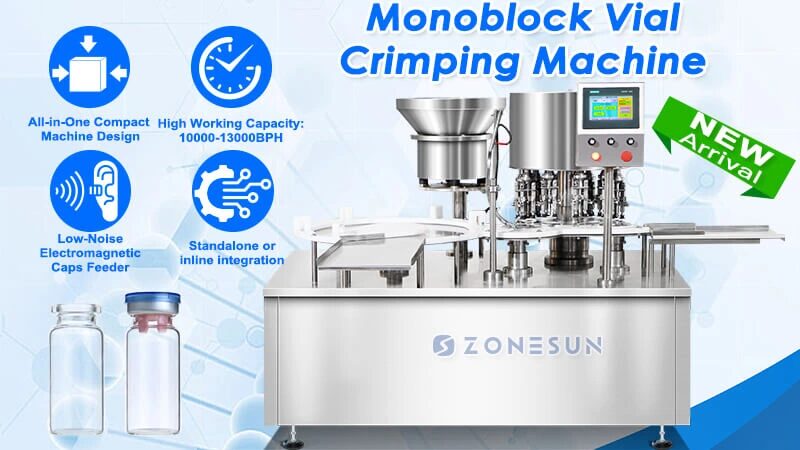
This machine uses the rotary crimping mechanism and combines automatic bottle loading, cap loading, and automatic capping in one operation. The machine can work alone or can be incorporated into a complete production line.
Key operational features include:
- Stable bottle conveying with consistent spacing
- Automatic cap sorting and feeding system
- Multi-roller rotary crimping for uniform sealing
- Automatic discharge of finished vials
The machine supports vial sizes ranging from 2 ml to 100 ml, making it suitable for various pharmaceutical production requirements. Its compact structure also allows flexible installation in space-limited environments.
In terms of capacity, it can reach up to approximately 200 bottles per minute, making it suitable for production environments requiring both efficiency and stability.
Comprehensive Advantages and Maintenance
Vial capping machines have many more benefits than manual capping systems when it comes to efficiency and consistency. Automation eliminates the possibility of human mistakes in addition to maintaining sealing uniformity.
To maintain long-term stable operation, proper maintenance is essential. Regular servicing not only extends machine lifespan but also minimizes downtime and production interruptions.
Key maintenance practices include:
- Cleaning and inspecting crimping rollers to ensure sealing quality
- Lubricating and checking the conveyor system for smooth operation
- Monitoring air pressure and mechanical stability
- Adjusting parameters when changing vial specifications
With proper maintenance, the equipment can maintain stable and efficient performance over long production cycles.
Conclusion
In conclusion, the importance of the vial capping machine in pharmaceutical packaging cannot be overemphasized as far as the automatic feeding process, accurate cap positioning, and crimping performance are concerned to ensure safety.
With continuous advancements in automation, equipment manufacturers such as ZONESUN continue to provide reliable capping solutions for different production needs. If you are looking for suitable equipment or technical support, you can contact us for further information and customized solutions.