
The round bottle labeling machine is an essential machine used today in packaging due to its applications ranging from beverages, cosmetics, and medicinal products to chemicals. The machine basically has the mandate of placing labels on round bottles accurately and effectively, meaning it is used to ensure consistency and high-quality work is achieved. The machine is used in small-scale and large-scale industries, and understanding the working mechanism of a round bottle labeling machine is important to manufacturers who take pride in high standards.
1. Basic Parts of a Circular Bottle Labeling Machine
- Labeling
The label mechanism is the essential part of every round bottle labeling machine, which is charged with the task of attaching the label to the bottle. The label is normally fixed on a roller and transported by rollers to the label head. Depending on the machine design, the label head could utilize friction, pressure, and adhesive transfer to attach the label. Some machines are capable of performing single- and double-sided label applications, depending on demand.
- Bottle Handling System
Bottle handling systems are used to move bottles to the labeling station. This is often associated with conveying systems, guiding systems, and turn tables. In automated systems, bottles are accurately aligned to avoid accidents and ensure correct label positions. Otherwise, bottles are aligned by an operator when semi-automatic systems are used.
- Control System
Modern round bottle labelers often feature an intelligent control system. Bottle sizes and locations are determined by sensors, and programmable logic controllers work to time the movement of the label carrier and the conveying system. In this case, high-speed and reliable applications are achieved. Other variables, such as speed, label location, and pressure, can also be adjusted to accommodate various sizes of bottles and types of materials used.
2. Operating Principle of Round Bottle Labeling Machines
(1) Label Application Process
The working principle of a round bottle labeling machine is based on synchronizing bottle movement with label application. When a bottle reaches the labeling position, the label is peeled from the roll and pressed against the bottle’s surface. Pressure rollers are used to ensure smooth label sticking. In some designs, single and double-label tools are possible.
(2) Adhesion
Several methods of adhesion are used to attach the label to bottles:
- Self-adhesive: The label has an adhesive already attached to it, and when pressure is applied, it sticks to the bottle.
- Hot melt glue: Certain models employ heated glue to attach the label to the bottle.
- Water-based adhesive: Less common, but applicable to specific packaging materials.
The selection of the adhesion technology is based on production needs, label materials, and bottle surface types.
3. Variants of Round Bottle Labeling Machines
Semi-automatic and manually controlled machines are used to package fewer products. The bottles are placed on the packaging machine by hand, either on the handwheel-equipped machine or on the machine with a conveyor. These are more economical and suitable to implementation in small workshops.
1)Manual and Semi-Automatic
Semi-automatic and manually controlled machines are used to package fewer products. The bottles are placed on the packaging machine by hand, either on the handwheel-equipped machine or on the machine with a conveyor. These are more economical and suitable to implement in small workshops.
2)Fully Automatic Machines
Fully automatic round bottle labelers operate under high-speed production and process several bottles every hour, ranging from hundreds to thousands. The machines comprise conveyors, automated label feeding, and sensors used to recognize bottle positions. They are common in the beverages industry, cosmetic factories, and pharmaceutical companies.
3) Specialized
There are specific machines used for specific applications, including:
- Front- and back-labeling arrangements (single versus double labeling)
- Equipment to label small bottles of cosmetic and pharmaceutical products
- High-speed machines intended for mass production of beverages
4. Advantages of Round Bottle Labeling Machines
- Enhanced Production Efficiency
The operation of round bottle labelers is highly efficient, increasing the speed of the entire process of labeling, which is not attainable when the process is manually conducted.
- Consistency and Quality
These round bottle labeling machines guarantee equal application of the label, reducing the possibility of creases, skewing, and air bubbles, which could affect a professional look.
- Versatility
Contemporary labelers are versatile and support various bottle sizes, shapes, and label styles. Such adaptability is most useful to companies producing several product lines, which enables easy changes without affecting label accuracy.
- Integration with Additional Equipment
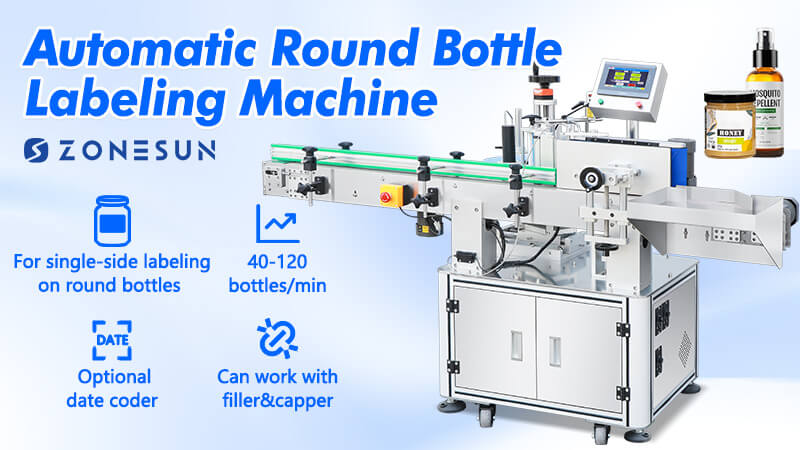
Some machines are manufactured to work seamlessly with filling and capping systems, which promotes the efficiency of an automated process and maximizes production time. As an example, the ZONESUN ZS-TB821 Vertical Single Side Round Bottle Labeling Machine is a desktop label maker with a three-roller design, which is efficient enough to label either single- or dual-surface printing on small bottles. The machine also does not require an air compressor, which is convenient when working with already installed automated filling and capping machines, and it is suitable for small-scale automated production.
5. Maintenance and Operation Guidelines
- Regular Maintenance
Regular cleaning of rollers, sensors, and interfaces between the adhesive and surfaces is necessary. Moreover, regular checks on wear and tear and replacing parts when due are important to avoid downtime.
- Safe Operation
Operators are to follow safety procedures, keep away from moving components, and follow the instructions provided by the round bottle labeling machine manufacturers. Training is important to operate machinery effectively.
- General Issues
Common problems include improperly aligned label positions, air bubbles, and inconsistencies with adhesion. These are normally fixed by adjusting roller pressure, speed, and label tension.
6. Conclusion
Knowledge regarding the working of round bottle labelers is paramount to manufacturers wishing to achieve efficiency, accuracy, and high-quality packaging. With models ranging from manually powered to completely automatic, round bottle labelers increase productivity and efficiency. ZONESUN specializes in round bottle labeling machines; their expertise ensures reliable performance and practical solutions for various production needs. For any inquiries or additional information, do contact us to reach out.