
These days, powder filling machines are very important for the food, pharmaceutical, chemical, and cosmetic industries. Powdered products are filled accurately and precisely using these machines, which saves human labor and also maintains the quality of the products. With the passage of time and the increasing needs of the markets, various kinds of powder filling machines have developed, each with special benefits and uses. This article provides a detailed description of the various types of powder filling machines and helps businesses choose the right machine for their needs.
Manual Powder Filling Machine
The most basic powder filling machine would be the manual powder filling machine. It can be easily operated, is very affordable, and ideal for small-scale production or for use in a laboratory setting. The filling process can be manually operated, usually by turning knobs or sliders, so the operator can easily control the powder filling amount and the speed of the process. The operator can also easily adjust to the powder properties.
Advantages:
- Low cost, minimal initial investment: Ideal for startups, laboratories, or small production lines, allowing powder packaging operations to start with minimal investment.
- Easy to operate, low learning curve: No complex training required, intuitive operation enables quick onboarding.
- Flexible for various powder types: Manual adjustments allow handling powders of different flowabilities, particle sizes, or slightly clumpy powders, increasing adaptability for small batch production.
Disadvantages:
- Low production efficiency: Can only process small quantities at a time, not suitable for large-scale production or fast turnaround.
- Accuracy depends on operator: Filling volume relies on the operator’s experience, which can lead to inconsistencies or require secondary inspection.
Semi-Automatic Powder Filling Machine
Semi-automatic powder filling machines add mechanization to manual operation. They usually feature automatic measuring devices, vibrating feeders, or electric filling mechanisms, reducing manual work while improving efficiency and filling accuracy. Operators only need to place containers and start the machine to complete powder measurement and filling.
Advantages:
- Several times faster than manual filling: Automatic measurement and vibration feeding significantly reduce filling time, ideal for medium-scale production.
- Reduced human error, higher accuracy: Electronic measurement systems ensure consistent fill weight, reducing waste and defective products.
- Handles a variety of powders: It can be used for powders with a medium flowability, granular powders, or slightly clumpy powders.
Disadvantages:
- Limited automation: The system still requires manual placement and removal of the containers, and it cannot be operated unattended.
- Higher investment than manual machines: Costlier than manual machines but relatively more economical than fully automatic machines.
Automatic Powder Filling Machine
Fully automatic powder filling machines come with a combination of measuring, filling, and sealing functions, and these types of machines can be used on a mass production level. Such machines do not need much manual operation, and the parameters alone need to be set to perform the entire production procedure. Depending on powder characteristics and production needs, automatic machines can be divided into the following types:
1. Auger Powder Filling Machine
Auger powder filling machines use a rotating screw to move powder into containers. The filling capacity can be varied depending on the speed and length of the screw. These machines are particularly useful in filling powdery substances with low flow and a tendency to form lumps, including powdered milk, protein powder, coffee powder, and drug powder.
Recommended Equipment:
- Automatic Rotary Bottles Powder Filling Machine: A classic auger-type fully automatic machine capable of filling multiple rotating bottles simultaneously. It ensures consistent fill weight per bottle, suitable for medium to large-scale food or pharmaceutical production, achieving continuous unmanned operation.
Advantages:
- Handles various powder flowabilities: Works with powders of different particle sizes and slightly clumpy powders, minimizing waste and rework.
- High filling accuracy: ±1g tolerance ensures product consistency, meeting food and pharmaceutical standards.
- Continuous high-volume production: Multi-bottle rotary filling reduces labor intervention and boosts output.
- Easy operation and maintenance: Equipped with HMI and intelligent controls, daily cleaning and maintenance are convenient, reducing downtime.
Disadvantages:
- Fine powders require dust control: Very light or airborne powders need dust covers or negative pressure extraction.
- Higher initial investment and maintenance: Costs more than semi-automatic machines.
- Requires larger footprint: Multi-bottle rotary design occupies more floor space, not ideal for small workshops.

2. Volumetric Powder Filling Machine
These machines fill by the volume of the container, not by exact weight. They have a simple construction, are easy to operate, and are inexpensive. They are really good for granular or free-flowing powders: sugar, common salt, and coffee powder. The accuracy of filling depends upon the size of the container and the density of the powder; thus, they are suitable for work where exact weight is not critical.
Advantages:
- Simple structure, easy to maintain: Fewer parts, low failure rate, easy cleaning.
- Low initial cost: Minimal investment for small production lines.
- Suitable for free-flowing powders: Powder flows easily, reducing clogging and improving continuous operation.
Disadvantages:
- Accuracy affected by powder density: Different batches may result in minor filling inconsistencies.
- Not suitable for fine or clumpy powders: Can lead to filling errors or blockages.
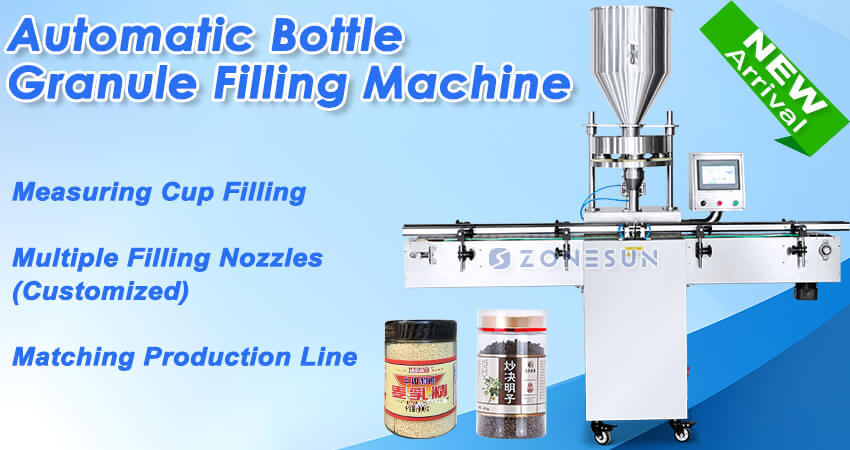
3. Net Weight Powder Filling Machine
Uses electronic scales or load sensors to precisely control the weight of each package, ideal for pharmaceutical, chemical, or high-value powders requiring strict weight control. Automatic calibration ensures consistent fill weight and reduces waste.
Recommended Equipment:
- 粉体計量充填機: Is an automatic weighing filler that uses an electronic scale to control each fill precisely. It ensures high accuracy with a tolerance of ±1g and significantly improves production efficiency, operating 3 to 5 times faster than manual methods. This machine effectively reduces powder waste and guarantees consistent package weight, making it an ideal choice for food and pharmaceutical powder production.
Advantages:
- High accuracy: Meets strict weight requirements for pharmaceuticals and supplements
- Automatic calibration: Reduces manual errors and ensures consistency
- Suitable for high-value powders: Minimizes losses and ensures quality
Disadvantages:
- Complex and costly: Requires significant investment and maintenance
- Requires stable environment: Needs level and vibration-free surroundings to maintain accuracy

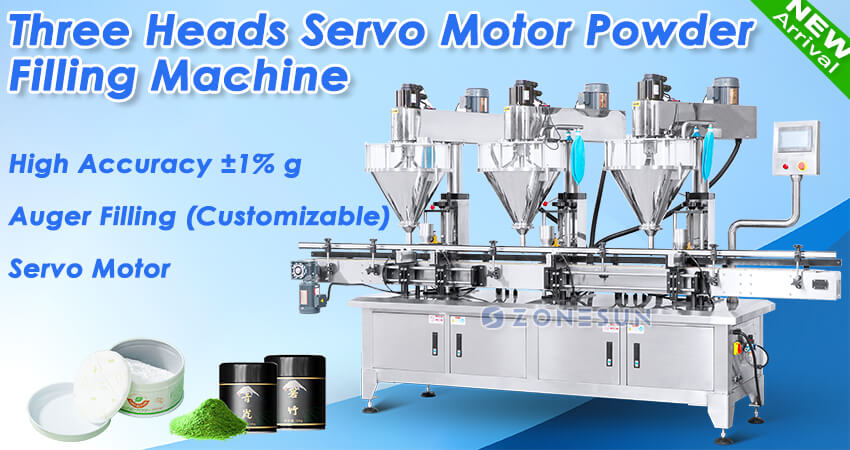
4. Multi-Head Powder Filling Machine
Multiple independent filling heads operate simultaneously, greatly increasing efficiency. Often combined with automatic conveyors for continuous operation.
Recommended Equipment:
3 ヘッド粉末充填機: Features a multi-head design with three independent filling heads working simultaneously, which significantly increases production output for large-scale food, pharmaceutical, and chemical powder operations. By filling multiple containers at the same time, it effectively reduces downtime and ensures continuous, high-efficiency production, making it ideal for businesses that require high-volume powder packaging while maintaining consistent product quality.
Advantages:
- High efficiency: Three heads fill simultaneously, shortening production cycles
- Stable accuracy: Each head measures independently, ensuring consistent weight
- Customizable configuration: The number of heads can be adjusted based on container size and production needs
Disadvantages:
- Complex equipment, higher maintenance: More heads increase maintenance requirements
- High initial investment: Best suited for high-volume production
結論
Different types of powder filling machines offer advantages in efficiency, accuracy, and application scenarios. Businesses should choose equipment based on product needs, powder characteristics, and budget. ゾーンサン offers a range of efficient and reliable powder filling solutions, catering to both small-scale and large-scale production. For more product information or professional guidance, please お問い合わせ, and our team will help recommend the most suitable powder filling solution to enhance your production efficiency and product quality.