
Das Kolbenfüllmaschine is a volumetric filler, dispensing a definite amount of liquid, semi-liquid, or viscous material into containers. It relies on a piston located in a cylinder to suck product from the tank and dispense it via a nozzle. The advantage of this principle is the ability to maintain a constant volume of filling and accurate dosage. Depending on the requirements, the machine may be used for small batch production or integrated in an automated packaging line.
How Does a Piston Filling Machine Work?
The filling cycle normally follows several coordinated steps.
1. Product Feeding
Product enters the system from a hopper or supply tank. For food, cosmetic, or pharmaceutical applications, the product-contact components may be selected for hygiene and material compatibility.
2. Piston Retraction
The piston moves backward and draws product into the cylinder. Thick products may require slower intake speeds to prevent air entrainment or inconsistent flow.
3. Volume Measurement
The piston travels through a defined distance, creating a measured filling volume. Adjusting the stroke changes the target quantity.
4. Piston Forward Movement
During the filling cycle, the piston in a Piston Filling Machine moves forward and pressurizes the product. Valves or other flow-control components then direct the material toward the nozzle for controlled and consistent discharge.
5. Filling the Container
The product is delivered into the bottle, jar, tube, or any other packaging through the nozzle. The nozzle construction and filling speed affect dripping, splashing, and foaming.
6. Repeat the Filling Cycle
After discharge, the piston returns to its starting position. Sensors and controls can synchronize container positioning, filling, and conveyor movement on automatic lines.
What Products Can a Piston Filling Machine Fill?
This filling equipment is widely used for products that require volumetric dosing and may have medium or high viscosity.
Lebensmittel
Examples are honey, sauces, syrups, jams, tomato puree, and some types of salad dressing. Stainless steel 304 or 316L may be used for product contact parts regarding hygienic and chemical requirements. Evaluation of the volume of filling, nozzle design, and the behavior of the product will enable manufacturers to have an accurate dosing process for various types of foods.
Cosmetic Products
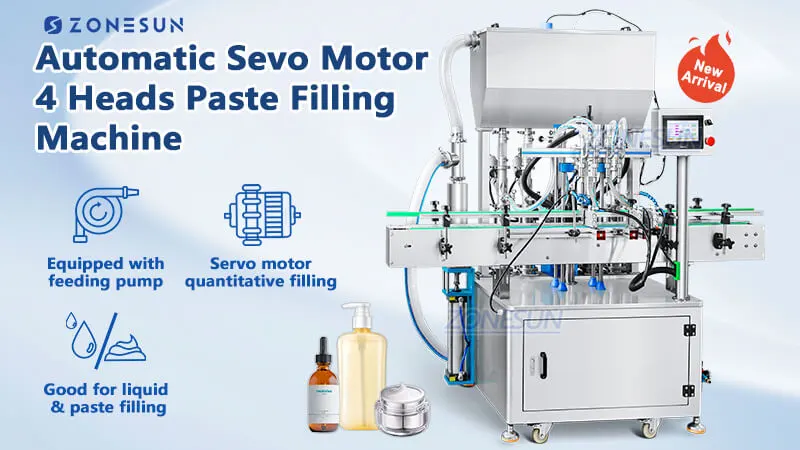
Lotions, creams, gels, shampoos, and body butters can be filled when the equipment is matched to their viscosity and formulation characteristics. For example, ZONESUN’s Cosmetic Filling Machine is designed with features that support consistent and flexible filling of cosmetic products:
- Servo-driven piston pump: Provides precise digital volume control for consistent dosing.
- Flexible filling configuration: Standard four-nozzle setup can be customized according to production requirements.
- Heating function: Helps maintain the flowability of creams, petroleum jelly, and wax-based products.
- Mixing function: Helps keep formulations evenly distributed during the filling process.
Pharmaceutical Products
Certain ointments, creams, and semi-liquid formulations may be suitable for Piston Filling Machine applications. These products require careful control of filling volume, material compatibility, and cleaning procedures. Stainless steel construction and appropriate product-contact components can help meet demanding production environments, while accurate dosing is important when each container must receive a consistent quantity.
Chemical Products
Adhesives, lubricants, detergents, and other industrial materials can also be handled. Seal and valve compatibility should be checked before production, particularly when working with corrosive or highly viscous formulations. The filling range, nozzle design, and optional heating or mixing functions should also be selected according to the material’s viscosity and flow characteristics.
Why Use a Piston Filling Machine?
The main advantages of this filling system come from controlled positive-displacement dosing.
1. High Filling Accuracy
Control of the piston stroke enables manufacturers to obtain accurate volume doses from their products. Manufacturers can minimize variation in each container by controlling the motion of the piston and filling volume, although the accuracy of such a process may depend on the product properties.
2. Suitable for Viscous Products
Positive displacement filling machines are appropriate where the items being filled have very high viscosity and cannot be handled using traditional gravity filling systems. The Piston Filling Machine uses the movement of pistons to dispense creams, pastes, sauces, syrups, and other viscous products while ensuring consistent dosing performance.
3. Flexible Filling Volumes
An adjustable piston stroke allows filling volumes to be changed according to different product and packaging requirements. This flexibility makes one filling system suitable for multiple container sizes, helping manufacturers switch between production specifications without requiring a completely different filling principle.
4. Reduced Product Waste
Piston dosing ensures that there is consistency in the quantity of items filled per unit. For instance, saving 2 grams in every item out of 50,000 will ensure a reduction of 100 kg in product usage.
5. Wide Application Range
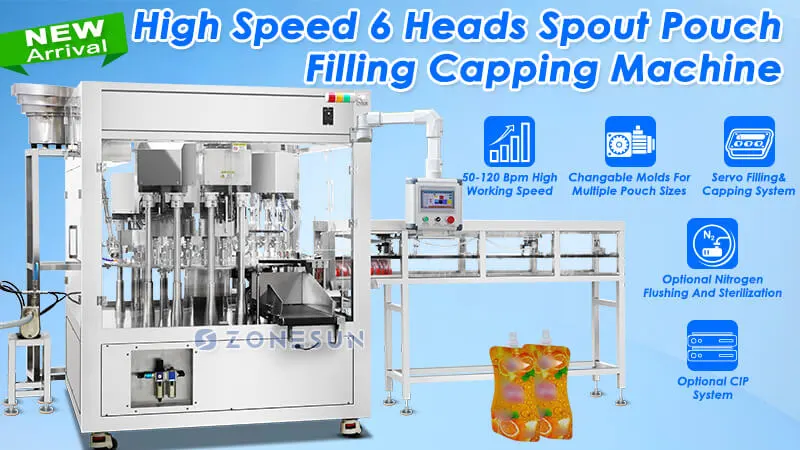
Piston filling machines can be customized according to various products, packaging styles, and manufacturing needs, which makes them quite flexible to use. This feature is especially useful for companies that deal with a variety of pouches and production processes. For example, ZONESUN’s ZS-AFC12M Servo High Speed Spout Pouch Filling Capping Machine is designed with features that support flexible and efficient pouch filling production:
- All-in-one automation: Integrates pouch feeding, pouch cleaning, filling, cap placement, and servo capping.
- Flexible packaging: Mold changes allow the machine to accommodate different spout pouch and cap sizes.
- Broad applications: Suitable for food, daily chemical, and automotive liquid products.
- Optional functions: Nitrogen filling and sterilization can be added for specific production requirements.
What Are the Different Types of Piston Filling Machine Systems?
A Piston Filling Machine can be classified by its automation level.
1. Manual Systems
Manual models are suitable for laboratories, startups, and small batches. Operators normally position containers and activate each cycle. They have a simple setup but lower throughput.
2. Semi-Automatic Systems
The semi-automatic machines relieve workers from performing the same operation repeatedly but still require manual assistance. Depending on the product type and operator process flow, they can produce several hundred to 1,000 bottles per hour.
3. Automatic Systems
Automatic machines can incorporate conveyors, bottling systems, cappers, and other packing stations. Using several filling stations increases productivity.
How to Choose the Right Piston Filling Machine?
Selecting suitable filling equipment should start with the product and production requirements rather than price alone.
1. Product Viscosity
Viscosity can change with temperature. A product that flows easily at 25°C may behave differently at 15°C, so testing is important for difficult materials.
2. Filling Volume
Define both minimum and maximum target volumes. A large cylinder is not automatically suitable for very small, precise fills.
3. Production Speed
Calculate required output from actual demand. A target of 3,000 bottles per hour requires the filler, conveyor, feeding system, and downstream equipment to operate at compatible rates.
4. Product Characteristics
Consider particles, foaming, temperature sensitivity, corrosiveness, and shear sensitivity because these factors affect nozzle, valve, seal, and speed selection.
5. Automation and Container Type
Choose manual, semi-automatic, or automatic operation according to production scale. Bottle opening, shape, material, and stability should also be tested with the actual container.
How to Maintain a Piston Filling Machine?
Regular maintenance helps preserve filling consistency and reduce downtime. Clean product-contact parts according to the product and hygiene requirements, and inspect pistons, cylinders, seals, O-rings, valves, and nozzles for wear or leakage. Operators should periodically verify filling volume instead of relying only on original settings. Weight checks can be performed at defined intervals and compared with the target value. Pneumatic systems should maintain stable air pressure, while moving parts should receive the lubrication specified by the manufacturer.
Fazit
A Piston Filling Machine is one of the useful solutions for those businesses that require volumetric control while filling liquids, semi-liquids, or viscous items. The piston filling machine technology provides flexibility in terms of fill volume and accuracy in operation and applies to both small-scale operations and automated manufacturing processes.
The proper setup will depend on the viscosity of the product, filling volume, production rate, nature of the product, container, and automation needed. Should you have any doubts about the equipment to use or would like us to evaluate your product needs, do not hesitate to contact ZONESUN.